Showing posts with label victorian. Show all posts

What is Jet?

Jet is fossilized wood. It has been used for making jewelry since ancient times. During the Victorian era, some of the finest Jet was mined from the cliffs of Whitby, England. Therefore, Whitby Jet in particular was in demand.

In 1851, The Great Exhibition of the Works of Industry of All Nations (sometimes referred to as the Crystal Palace Exhibition) was held in London. One of the Exhibitions featured Jet jewelry and its popularity quickly grew when it enjoyed royal patronage almost immediately.

When Queen Victoria’s husband, Prince Albert, died in 1861, Queen Victoria went into mourning and allowed only Jet jewelry to be worn at court. As usual, society followed court etiquette and Jet became very fashionable for mourning. However, though Jet was important for mourning jewelry, it continued as a very popular material for mainstream jewelry in general. Many non-mourning pieces were made from Jet.


Eventually production of Jet jewelry could not meet the demand so other similar-looking materials were substituted, such as French Jet (glass) or Vauxhall glass, or Vulcanite (a natural, hard rubber).


How to Distinguish Jet 

When rubbed against unglazed porcelain, true jet will leave a chocolate brown streak. Unlike glass, Jet is  warm to the touch. Also, when rubbed briskly onto silk or wool, true Jet will develop static electricity much like Amber.


Vulcanite: A Fashion Trend

Rubber Victorian jewelry? Yes indeed!

Upon the death of Queen Victoria’s husband, Prince Albert, black jewelry became the height of fashion as the queen chose to wear black the rest of her life. Consequently, black jewelry was fashioned from a wide variety of materials. One of those materials was Vulcanite.

Vulcanite is a substance formed by combining sulphur and India rubber, a natural rubber, and then heating - or vulcanizing - the mixture. It becomes a hard, black material, originally intended to take the place of ebony wood. Charles Goodyear is generally given credit for developing the process and his patent occurred in 1844.

Vulcanite (sometimes called Ebonite) can be confused with other substances such as Gutta Percha, Jet, French Jet, or Bog Oak. It helps to know that Vulcanite is a molded material with rounded edges, not carved with sharp edges like Jet or French Jet. It can be polished to have a matte sheen, but the finish will never be as glossy as Jet or French Jet. Bog Oak has growth lines since it is wood, but Vulcanite does not.

Gutta Percha is also a molded material, but it was almost always used for making utilitarian household and commercial items such as boot soles and gussets, buttons, carriage belts, tubs, pails, cables, golf balls, etc. Vulcanite, on the other hand, was used for every imaginable type of jewelry - earrings, brooches, watch fobs, lockets, etc. Originally manufactured as black jewelry, over time Vulcanite can turn brown.

Another way to try and identify whether or not the material is Vulcanite will be to rub the piece and if it is Vulcanite, it will smell like rubber.  If all else fails, you can do a taste test. Yes, actually lick the piece!  If the item tastes salty, it’s Gutta Percha. If not, it’s Vulcanite. If you don’t want to do the taste test, assume that the jewelry is Vulcanite and you’ll be right most of the time.

Here are some pictures from my collection. And just for fun, at the bottom is a pair of earrings in my shop made with genuine vintage Vulcanite! 

Victorian Vulcanite Lockets and Chains. Holly Sheen Collections.


Victorian Vulcanite Pendants. Holly Sheen Collections.


Victorian Vulcanite Bracelet. Holly Sheen Collections.

Victorian Vulcanite Brooches. Holly Sheen Collections.

Victorian Vulcanite Hair Combs. Holly Sheen Collections.


Gloves in the Mid-1800s

Gloves have been worn for thousands of years. Some gloves were utilitarian, some were symbolic parts of a costume or ceremony, and some were purely a fashion accessory. Since at least the 17th century gloves have been available in three broad categories—leather, fabric, and knitted. Initially gloves were made entirely by hand. In the early 19th century technical innovations began to take place and eventually some mechanization was introduced later in the century.

In the 1860s, gloves are a fashion requirement. Though one can find exceptions in looking at CDVs, generally no lady would be out in public without her gloves. At this point in time gloves are wrist-length and come in a wide variety of materials and colors.

I have compiled a number of excerpts from various sources to give you an overview regarding gloves.

Blue Leather Gloves
Holly Sheen Collection
American Family Encyclopedia of Useful Knowledge or Book of 7223 Receipts and Facts: A Whole Library of Subjects Useful to Every Individual, by T. Webster and Mrs. Parkes (1856)
Gloves are made of various materials; leather, silk, linen thread, cotton thread, cotton cloths, and worsted. The good qualities of gloves are strength, warmth in winter, coolness in summer, elasticity in fitting well, and to be well sewed in the seams. There is a distinction, also, between those which will bear washing and such as will not; likewise in the manner of sewing. 

Of leather gloves there are a great many kinds, according to the quality of the material or the uses for which they are required. Of these the principal are:

Kid gloves, the most beautiful, from their softness, thinness, and elasticity, fitting the hand almost like a second skin. They are white, and dyed of all colours, but white kid is always worn in full dress. Limeric gloves…..Beaver gloves….Woodstock gloves…..Buck-skin….Doe-skin….Tan leather….

Thread gloves are either of linen or cotton thread; but it is the former only that are properly known in the shops by the name of thread gloves….They are a remarkably cool wear in the summer….

Cotton gloves are the cheapest of all and are dyed of various colours….

Jean, sateen, and cambric gloves are cut out of cotton cloth of these names, and sewed together , their use is confined to women.

Silk gloves….The French white are the best; they are also black, and coloured…Gloves are now also made remarkably cheap of spun silk.

Worsted gloves are of many kinds……Worsted gloves, though not so elegant as others, have a great advantage in their real warmth in cold weather.

The above gloves, of silk, cotton, and worsted, and thread, are now generally woven in the loom; knit gloves formerly so common, being seldom to be met with….Elastic wristbands to gloves are a late improvement.


Lavender Leather Gloves
Metropolitan Museum of Art
Gloves, Past and Present, by Willard M. Smith
It was not until the thirteenth century that the ladies of Europe blossomed forth in gloves—not of the mitten variety, but boasting four fingers as well as a thumb. The first to be introduced for the fair sex were made of linen, of simple design, and reached to the elbows to accommodate the short-sleeved gowns of the period. Not before Queen Elizabeth’s time, however, did the elaborately embroider, bejeweled and perfumed glove captivate woman’s fancy and satisfy her feminine dreams of beauty and extravagance.

….The truth of the matter was, French glovemakers early had won the first place in Europe. Struggle as she might, it is exceedingly doubtful whether her rival across the Channel [England] ever could have equaled her prestige. In the seventeenth century, Paris and Genoble enjoyed the monopoly of the glove markets of Europe…During the eighteenth century, however, these cities began to cope with Germany, Italy, Austria, and even Russia, in glove-making.

…About the year 1819, Vallet d’Artois, a French glove manufacturer, invented steel punches in three sizes, each of which would cut, or punch, out of leather two dozen gloves at once. This invention was the first step toward the introduction of modern machinery into the glove industry….

By minutely studying hands in the Hospital of Grenoble, [Xavier] Jouvain discovered and wrote out….thirty-two different sizes of hands. He furthermore recognized five types…this made three-hundred-and-twenty different numbers of gloves…he had discovered the caliber [pattern] in 1834 [and patented it]…

A later contribution to the technique of the glove was the modern style of fastener, introduced about 1855, by M. Raymond of Grenoble….Roux gives credit to Raymond for all the various changes and improvements in glove fasteners which we have today.

At the Opera by William Powell Frith
Gloves, by Valerie Cumming
At the beginning of the seventeenth century it was possible to buy all three types of glove that are available to us today, namely leather, fabric and knitted gloves....

--Regarding leather gloves--
In the eighteenth and nineteenth centuries there were a series of inventions in the textile industry and allied trades which mechanized many processes which had previously depended on the employment of large numbers of handworkers. Many of these advances were resisted, either by workers who were afraid of losing their livelihood, or by the master craftsmen who felt that no machine was capable of rivalling the skills and experience of trained workers……It was left to Xavier Jouvin, a young French medical student who came from Grenoble, the centre of French glovemaking, to develop this idea….he invented a glove pattern or caliber which he patented in 1834….All modern methods of glove sizing and pattern cutting are based on Jouvin’s system.

The other major development which speeded up glove manufacture was the adaptation of the sewing machine to the finicky and specialized stitching of the glove trade.

--Regarding fabric and knitted gloves—
Gloves or mittens of linen, silk or cotton and cut out and sewn in the manner of leather gloves, were not originally considered an adjunct of the glovemaking trade. In the seventeenth and eighteenth centuries they were usually made and supplied by the milliner or dressmaker….The skills required were essentially dressmaking ones, and the gloves or mittens made from fabric were often ordered or purchased because they complemented a particular dress, and because they were cooler and lighter to wear in warm weather or crowded rooms. Their major disadvantage was that they were rarely well fitting, and after one of two wearings they quickly lost their shape and any pretense of fit…..Today fabric gloves are considered a separate category from knitted gloves, but the two areas overlapped considerably during the period 1770-1870.

 
--The etiquette—
The etiquette of glove wearing was an important feature of nineteenth-century life…

The attributes of the perfect lady, the ideal to which many nineteenth-century writers and journalists in women’s magazines directed the aspirations of the susceptible included small hands and small feet. Hands could be made to appear smaller by being mercilessly crammed into tight gloves (it is no accident that glove stretchers appeared at this time to assist the vain purchaser in easing their gloves)...…

Gloves 1860-80 -- Short leather gloves with long lines of pointing on the back of the hand were worn by men and women of all classes in the latter half of the 19th century…..


Glove Making, The Art & The Craft, by Gwen Emlyn-Jones
As a matter of personal ornament, gloves—as distinct from utilitarian gloves—do not seem to have been in general use in Britain until about the thirteenth century, when women began to wear them, usually of linen and reaching the elbow. It was Queen Elizabeth, some three centuries later, who definitely fixed the glove as part of the etiquette and manners of social life.

Perfumed gloves became so universal that they were often given at the universities to college tenants as well as to guests of distinction. They are mentioned by Shakespeare. Winter’s Tale sings of ‘Gloves as sweet as damask rose’, and in Much Ado About Nothing Hero says to Beatrix—‘These gloves the Count sent me, they are an excellent perfume.’ Incidentally, Shakespeare’s father was a glover.


Lady with Gloves
Holly Sheen Collection
Hints on Etiquette (1837)
[To men] Do not insist upon pulling off your glove on a very hot day when you shake hands with a lady. If it be off, why, all very well; but it is better to run the risk of being considered ungallant than to present a clammy ungloved hand.

[Both sexes] Always wear your gloves in church or in a theatre.

[Women] Ladies should never dine with their gloves on – unless their hands are not fit to be seen.


The Behavior Book: A Manual for Ladies (1855)
Above all, do not travel in white kid gloves. Respectable women never do.

It is not admissible to try on kid gloves in a store. After buying a pair, ask for the glove-stretcher, (which they keep in all good shops, for the convenience of the customers,) and then stretch the gloves upon it, unless you have a glove-stretcher at home. This will render them easy to put on when you take them into wear. Glove-stretchers are to be bought at the variety stores; or ought to be. They will save many a new glove from tearing.


The American Family Encyclopedia of Useful Knowledge, or Book of 7223 Receipts and Fact (1859) P. 998

#5907
Kid gloves, the most beautiful, from their softness, thinness, and elasticity, fitting the hand almost like a second skin. They are white, and dyed of all colours, but white kid is always worn in full dress.

#5908
Gloves are made of various materials; leather, silk, linen thread, cotton thread, cotton cloths, and worsted. The good qualities of gloves are strength, warmth in the winter, coolness in summer, elasticity in fitting well, and to be well sewed in the seams. There is a distinction, also, between those which will bear washing and such as will not; likewise in the manner of sewing.

#5909
Machines have been lately invented for sewing leather gloves, by which the process is performed more accurately, and which reduces the price.

#5910
Thread gloves are either of linen or cotton thread; but it is the former only that are properly known in the shops by the name of thread gloves, though it is now a common practice to pass off cotton thread for linen thread. They are a remarkably cool wear in summer, and bear washing perfectlyly; they are sometimes of unbleached yarn.

#5911
Cotton gloves are the cheapest of all, and are dyed of various colours; being warm, they are much in use for common wear.

#5914
Silk gloves; these are of various qualities, determined by their weight and the neatness of the workmanship. The French white are the best; they are also black, and coloured. A figured silk net glove has lately come much into use among ladies; it is extremely elegant, and cool in summer. Gloves are now also made remarkably cheap of spun silk.

#5915
Worsted gloves are of many kinds…..Worsted gloves, though not so elegant as other, have a great advantage in their real warmth in cold weather…….Elastic wristbands to gloves are a late improvement.


Cotton Gloves
Metropolitan Museum of Art
P. 1076

#6476
Wash-leather gloves, as their name implies, may be easily washed with soap and water; when nearly dry, the fingers should be stretched with a piece of wood.

#6477

White and coloured kid gloves are more difficult to clean; but it is said they may be cleaned perfectly by laying them on a clean towel, rubbing them with a piece of flannel dipped in a hot, strong lather of white soap, till the dirt is removed, using as little water as possible. Hang them up at a distance from the fire to dry gradually, and after they are quite dry, pull out the shrivels and stretch them on the hand.

Peterson’s, February 1860
A Paris letter writer states that, as an addition to the ball-room toilet, the distinguished perfumer and glove-maker, Faguer, stitches the white kid gloves with blue, pink, or violet silk, according to the color of the robe with which the gloves are to be worn. The glove, fastened with two buttons on the back of the wrist, is also a novelty.

Peterson’s, April 1860
There is a new caprice in gloves, which has the merit of novelty, if not of beauty—none other than the long Spanish gloves, embroidered in gold or silver, and which will soon, they say, become indispensable additions to a grand toilet.

Peterson’s, September 1860
Kid gloves, or those of Saxon leather embroidered, may now, more easily than ever, be found to match the colors of the dress, for we see them of several new tints, such as gillyflower, deep green, and blue; but very light gloves, as straw or maize, will always be the most stylish, and the only ones that form a suitable complement to an elegant toilet.

Peterson’s, October 1860
The Venetian gloves, which we noticed last winter as a great novelty, are now quite popular. These gloves are embroidered, and bound with a color contrasting with that of the leather, and fasted above the wrist by six small gilt buttons.

Etiquette For All or Rules of Conduct (1861)
Gloves, trifling as they may appear, give the finishing touch to a lady’s dress. They should invariably be worn when out of doors, whether visiting, shopping, at church, concerts, or any place of amusement or public resort. White gloves are worn only in full dress; the colour of the dress should regulate the hues of those worn on other occasions.

English Women’s Clothing in the Nineteenth Century, by C. Willett Cunnington
1861--
Paris kid [gloves], two button….one button…
1862--
Gauntlet gloves for wearing with ‘yachting jackets’


Peterson’s, April 1862
Kid gloves of light color, with one or two buttons, and embroidered in little squares at the back of the hand, are the most distingue.

Peterson’s, February 1864
These now indispensable articles of the toilet were not generally deemed necessary in England until the days of Queen Anne, although their origin is of sufficient antiquity for Xenophon to mention them as a proof of the effeminancy of the Persians. We have Cicero’s authority for saying their use was long customary with the Romans. In the middle ages, gloves were used only by the aristocracy of England, and highly ornament. Even when general in Queen Anne’s time, they were so highly esteemed as to form a customary New Year’s gift.

Peterson’s Magazine, December 1864
Those pleasing hues of yellow, brown, or tan color, are readily imparted to leather gloves, by this simple process; Steep saffron in soft, boiling water for twelve hours; then, having sewed up the tops of the gloves to prevent the dye from staining the insides, wet them over with a sponge dipped into the liquid. The quantity of saffron, as well as of water, depends on how much dye maybe wanted, and their relative proportions on the depth of color required. A common teacup will contain quite sufficient in quantity for a single pair of gloves.

Ecru Leather Gloves
Holly Sheen Collection
Godey’s Lady’s Book, 1860
Where dancing is expected to take place, no one should go without new kid gloves; nothing is so revolting as to see one person in an assembly ungloved, especially where the heat of the room, and the exercise together, are sure to make the hands redder than usual.....

Straw-colored gloves, with two buttons, and worked with lavender color.

Godey’s Lady’s Book, 1861
…The gloves have two buttons at the wrist and scalloped tops.

The Josephine gloves, of a peculiar cut, and the Mathilde glove, bordered at the wrist with a row of dahlia leaves, stamped out, are to be seen on the hands of our belles.

White bonnets are the most becoming to all complexions, but should almost invariably have white strings, to admit of any color dress being worn, as strings of an opposite and not harmonious contrast will spoil the whole appearance of the toilet. The same remark may be applied to the gloves, which should be in strict union with the dress, and if possible, be obtained of the same hue, and where not, steel or stone, or drab-colored or black, for ordinary wear, and lemon-colored for dress.


Godey’s, Lady’s Book, 1862
Gants de Swede, or undressed kid gloves with embroidered backs, are now very fashionable. They are to be had of all colors and styles, and are less expensive than the finished kid gloves.

Godey’s Lady’s Book, 1863
Uniformity of color is one of the principal characteristics of a fashionable toilet at the present day. In Paris, ladies adopt one color for bonnet, mantle, dress, gloves, boots, and parasol. Frequently, also, the petticoat is of the same color.

To Wash White Thread Gloves and Stockings—
These articles are so delicate as to require great care in washing, and they must not on any account be rubbed. Make a lather of white soap and cold water, and put it into a saucepan. Soap the gloves or stockings well, put them in, and set the saucepan over the fire. When they have come to a hard boil, take them off, and when cool enough for your hand, squeeze them in the water. Having prepared a fresh cold lather, boil them again in that. Then take the pan off the fire, and squeeze them well again, after which they can be stretched, dried, and then ironed on the wrong side.


Godey’s Lady’s Book, 1864
We saw at Stewart’s quite a novelty in kid gloves. They were of light colors covered with little waving lines or small stars or pin dots. We mention these merely as a novelty, for they are far from pretty. We particularly admire the buff, stitched with black, and the pure white ones.

Silk gloves have just appeared with Tartan gauntlets, and we suppose will be adopted.


Hillgrove’s Ball Room Guide and Practical Dancer (1863)
The gloves should fit to a nicety.

Gloves should be removed at the supper-table. Servants in waiting are the only persons privileged to wear them.


The Fashionable Dancer’s Casket or the Ball-Room Instructor (1856)
The gloves should fit to a nicety.


Rose O'Neal Greenhow with gloves that "fit to a nicety!"

1860s Ladies Wore Earrings!

Victorian ladies loved earrings!

Not every woman of the 1860s wore earrings, of course. But with hairstyles generally showing the earlobes once again, earrings returned to popularity. Earrings varied in size from petite little dangles to larger ‘drop’ earrings.

Photographs, paintings, and fashion magazines of the era all featured earrings on ladies.

Below is a page from Le Mode Illustree, a popular fashion periodical from the era. Notice there are two earring designs feature on it. The date is December 25, 1864.


They Were Affordable 

By the mid-1860s, the industrial revolution had been underway for quite some time. This opened up many new techniques and materials used for jewelry.  Faux jewels had been in use for centuries, but now cheaper metals had been developed also. Ladies of the middling classes, not just the wealthy, could now afford to wear jewelry.

They Were Worn By All Ages

Also, just like now, a wide range of ages wore earrings. Photographs and paintings show young girls, middle-aged ladies, and older ladies all wearing earrings.

Young Girls Wearing Earrings


No Posts, Screws or Clips

In the 1860s, ears were pierced for earrings. Sources differ as to exactly when, but screwback, clip-on, and post earrings were not invented until decades later. Earring backs were usually simple 'shepherds hooks' and some also had a latch for the hook.

Don't you love this lady's massive earrings? They appear to be cameos, likely coordinating with her brooch.


I enjoy creating earrings using some of the materials and motifs that were popular in the 1860s. Here's a peek at a few of the items I currently have listed.

Click here to see more! 


Turquoise in the 1860s

Turquoise was a popular gemstone during the 1860s, but it had a long history of popularity. Other cultures had valued turquoise and used it decoratively for centuries before.

Turquoise made its entrance into the western world primarily through Persia and Egypt, thanks to Napoleon’s inroads to North Africa via his military campaigns. Shortly after the 1798 Battle of the Nile, wealthy women across Europe began wearing the stone in their jewelry.

Persian turquoise differs from turquoise mined in the United States in that it has no visible matrix. Matrix is the black or brown veining that is common here in our country. Instead, the turquoise that Victorians were familiar with was a fine robin’s-egg blue. To our eyes it almost looks fakey since it has no veining, but it was very much prized in the 1860s and continued to increase in popularity.

Here are some lovely examples of mid-Victorian turquoise jewelry.

Seen on Morning Glory Antiques
Seen on eBay
Seen on Ruby Lane Antiques

Just for fun, I occasionally incorporate a little turquoise into my jewelry such as this pair of earrings.

Purchase at Southern Serendipity

The History of Roman Pearls

Pearls are a timeless classic that have been prized for centuries. They are mentioned in the Bible and in ancient Chinese and Roman records, for example. Natural pearls were rare and expensive so that only the wealthy could afford to own them. In fact, they seem to have been quite the status symbol. The Roman emperor Julius Caesar passed a decree mandating that only aristocrats could wear pearls within the boundaries of Rome.

As with many expensive products, efforts at creating a cheaper look-alike alternative to the natural pearl were sought. Several attempts are notable. The ancient Romans coated glass beads with silver and then over-coated with glass again in an attempt to replicate genuine pearls. Another idea was to coat small balls of clay with mica powder and then bake them.

Ablette - a fish whose scales were used to manufacture faux pearls
Later on glassmakers in Venice came up with a couple of approaches. One was to use powdered glass and egg whites, and snail slime, and the other was to use shells and fish scales. The faux pearls were apparently so authentic looking that the Venetian pearl merchants successfully lobbied to make it illegal to produce them. Eventually elsewhere in Italy another process was invented, that of using alabaster coated with an essence extracted from fish scales. These were called Roman Pearls. Also, in the 1700s a Paris rosary maker, M. Jacquin, patented a method using hollow blown glass spheres that were coated on the inside with ground fish scales and then filled with wax to give them a weight similar to a natural pearl.

A plate from Diderot’s "Encyclopédie"
showing faux pearl manufacturing
In A History of British Fishes, published in 1836 by William Yarrell, he gives details about the extraction of the pearlescent lustre from the scales of the fish.

On the inner surface of the scales of Roach, Dace, Bleak, Whitebait, and other fishes, is found a silvery pigment, which gives the lustre these scales possess. Advantage has been taken of the colouring matter thus afforded to imitate artificially the Oriental pearl. When this practice was most in fashion, the manufactured ornaments bore the name of patent pearl, and the use was universal in the bead-trade for necklaces, eardrops, &c. At present, it seems confined to ornaments attached to combs, or small beads arranged with flowers for head-dresses. So great was the demand formerly at particular times, that the price of a quart measure of fishscales has varied from one guinea to five. The Thames fishermen gave themselves no trouble beyond taking off the side scales, throwing the fish into the river again; and it was the custom for hawkers regularly before selling any white-fish, as they were called, to supply the beadmakers with the scales.

Vintage Roman pearls seen on the
Portobello Market

The method of obtaining and using the colouring matter was, first carrying off the slime and dirt from the scales by a run of water; then soaking them for a time, the pigment was found at the bottom of the vessel. When thus produced, small glass tubes were dipped in, and the pigment injected into thin blown hollow glass beads of various forms and sizes. These were then spread on sieves, and dried in a current of air. If greater weight and firmness were required, a further injection of wax was necessary. Of this pigment, that obtained from the scales of Roach and Dace was the least valuable; that from the Bleak was in much greater request; but the Whitebait afforded the most delicate and beautiful silver, and obtained the highest price, partly from the prohibitory regulations affecting the capture of this little fish, the difficulty of transmission, and rapid decomposition.


Before too long mass-production of faux pearls, sometimes called Roman Pearls or Parisian Pearls, was underway in a number of places, enabling more than just the aristocracy to afford them. Some of these interior-lined-glass processes endured until WWII.

So regardless of which era you portray in reenacting - or even for your modern outfits - wear your lovely faux pearls knowing that you are carrying on a time-honored tradition!
Georgian Roman pearl earrings. Seen on 1stdibs.com. 


If you're looking for a pair in mid-Victorian style, I have a number of options in my Etsy shop. Enjoy!

Available in my shop

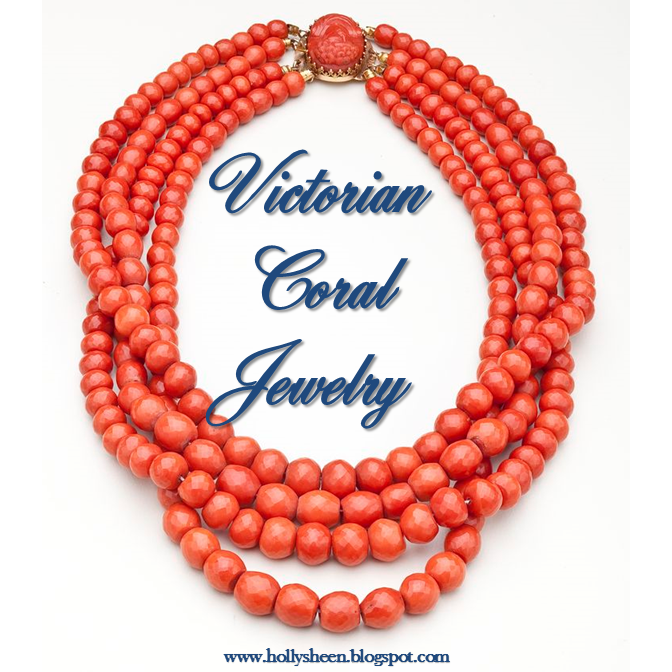
Victorian Coral Jewelry

“Florrie, too, looked very lovely, in her little white dress and coral armlets and necklace, her golden hair curling in little short ringlets all over her head, and her cheeks the color of a May rose.”  Godey’s Lady’s Book, June 1860 [emphasis mine]

The term ‘coral’ describes a vast group of marine invertebrates (animals without backbones). There are at least 100,000 known species throughout the world, and they are found everywhere - from the polar regions to the equatorial regions, and all depths from the intertidal zone to the deepest ocean trenches. Coral also occurs in an amazing array of colors - white, orange, pink, red, tan, gray, lavender and blue, all the way to black.

Coral has been used for jewelry and decorations for centuries by many peoples and has been traded around the world. The Victorians loved coral and an endless variety of beautifully carved jewelry dates from the era.

Because it is fairly soft, coral can easily scratch and scuff. Prolonged lights can cause it to darken and excessive heat can damage the finish. Even sweat from one’s hands can soften coral over time. Therefore, coral jewelry should be carefully taken care of. It is most safely stored in a cloth bag in controlled temperature.

A range of ages wore coral in a variety of ways, as the following quotes and pictures will illustrate:  

Fig. 2.  Zouave jacket of blue armure silk, embroidered.
The shirt, with wide bouffant sleeves, is made of white muslin,
buttoned up in front by a row of coral buttons or studs.
Godey's Lady's Book, July 1861


“Dress for evening, of perfectly plain white grenadine. The under skirt has three flounces of moderate width; the upper one is perfectly plain. There is no pattern, no edge of any description, to the flounces, sleeves, or waist - the richness of the material obviates it - with the exception of a rich satin ribbon, also of plain white, which forms the heading of the berthe, and has a bow on each shoulder and in the centre of the corsage, bracelets and belt-clasp of gold, set with red coral.”   
Godey’s Lady’s Book, July 1860


Le Bon Ton, March 1857

“The headdress consists of a wreath of the foliage of the service tree, intermingled with festoons of coral beads.”  
Godey’s Lady’s Book, September 1860

Portrait of Maria Sawiczewska, Leopold Loeffler, 1861
“The articles in wear for so long a time have been added to this fall - notwithstanding the pressure of the times, and the economical resolves of most families. Among them we note the rich combs of coral, ivory, silver, and gold, intended for evening wear, in full dress.”  
Godey’s Lady’s Book, September 1860

Detail, "Young Roman Girl with Basket of Fruit" (1847)
Johann Endler

“The newest hair nets are made of small shells or coral. They are very pretty and dressy.”
Godey’s Lady’s Book, September 1864

Ferdinand Schauss, Portrait of his wife, 1863
They even had recipes for faux coral as illustrated by this entry from Godey’s.

"ARTIFICIAL CORAL — This may be employed for forming grottos and for similar ornamentation. To two drachms of vermilion add one ounce of resin, and melt them together. Have ready the branches or twigs peeled and dried, and paint them over with this mixture while hot. The twigs being covered, hold them over a gentle fire, turning them round till they are perfectly covered and smooth. White coral may also be made with white lead, and black with lampblack, mixed with resin. When irregular branches are required, the sprays of an old black thorn are best adapted for the purpose; and for regular branches the young shoots of the elm are most suitable. Cinders, stones, or any other materials may be dipped into the mixture, and made to assume the appearance of coral." 
Godey’s Lady’s Book, August 1860

Comtesse Sauvigny, nee Marie Alice Singher by Auguste Pichon 1858
If you love coral as much as I do and need something pretty and Victorian, check out the coral in my shop! Here's a peek at some of my coral jewelry. Thanks for reading!


To Match or Not To Match

There is an ongoing discussion among reenactresses as to whether or not ladies of the 1860s matched their accessories to their dresses. On one end of the spectrum we see uninformed ladies buying cloth and making the dress, purse, and shawl out of it - all matching. On the other end we find reenactors cautioning us against being "matchy matchy" in any way. Period. As with all extremes, research shows us that the middle road is usually the most accurate.

In looking at engravings, fashion plates, and paintings of the times, it looks like 1860s ladies both matched and contrasted - just like we do today. While they didn't make their dresses, purses, and shawls out of the same material, they did often coordinate the colors.

Since a picture is worth a thousand words, following is a small sample for illustration.

Notice the lady on the right is wearing a pink dress and matching pink flowers in her hair. However, the lady on the left has chosen to accent her blue gown with white and green - contrasts.
Le Bon Ton, April 1863

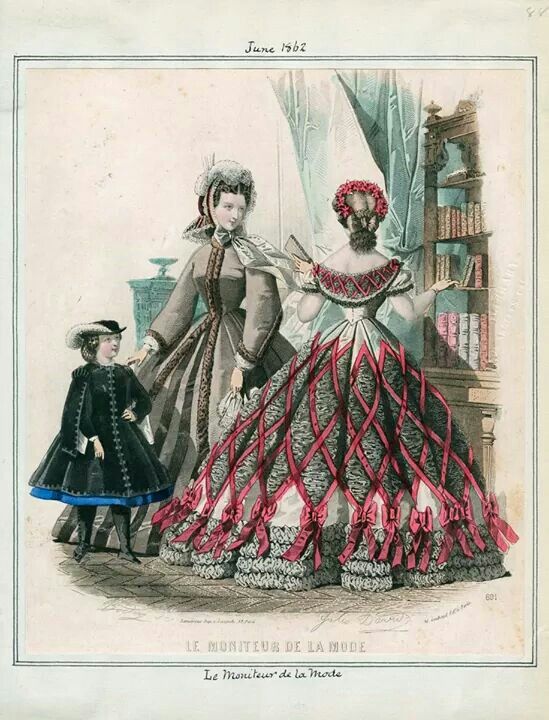
In this fashion plate we see a lady matching her hairpiece to the trim on her dress.
Le Moniteur de la Mode, June 1862

Lest you think that matching is merely a fluke of the person adding color to these fashion plates, here is a formal painting showing some beautiful color matching. Only two shades of blue are used in the ensemble.

Mathilde, by Peirre Franois Eugene Giraud, 1861

Below is a helpful example of both matching and non-matching ensembles. We see the lady in white wearing the same roses on her dress that she has in her hair. On the other hand, we see a lady in purple and yellow wearing red trim! Wow! The lady in the middle front is quite harmonious as she uses pink, white and green florals to compliment her pink dress.

Godey's Lady's Book, January 1862

If you want to see some real "matchy matchiness" going on, take a look at these ladies! Both of them are wearing matching ribbons and flowers on their cap or bonnet. 


Le Monieur de la Mode, 1861

The lady below has matched her cap ribbons to the trim on her morning wrapper. 

Musee des Familles, 1860

Here is another gorgeous example of a complete contrast. This lady has chosen to accent her black dress with striking coral jewelry. 

Portrait of Marii Sawiczewskiej, 1861

This painting  below by John Bagnold Burgess is about as non-matching as you can get - pink dress, black and white hat, gold and white striped shawl and purple parasol!


I'll end with a lovely painting that shows both elements - matching and non-matching - in one lady's outfit. Notice that her neck bow and bonnet ties are apparently created from the same ribbon. However, notice that the bonnet itself is yellow, with a different shade of berries. And her gorgeous shawl has just about every color of the rainbow!

"Look At The Time" by Gustave de Jonghe

It seems pretty clear that Victorians enjoyed both matching and contrasting. The important thing to consider when creating your ensemble is not necessarily whether all of the colors match or not, but whether you are using the right materials for each item. This should rule out the improper "matchy matchy" look of the non-researcher, because we don't typically use the very same materials for every ensemble item - dresses, bonnets, purses, shawls, etc. Once you choose correct materials, enjoying matching or contrasting - it's up to you!