Showing posts with label jewelry. Show all posts

Bog Oak As Jewelry - Really?


Yes, really! Bog oak was quite popular as jewelry beginning in the early 1800s and remained trendy for most of the Victorian era. When Queen Victoria went into mourning at the death of Prince Albert, she ensured that black would remain a fashion color for decades. As the fashion icon of the era, everyone tried to emulate the beloved queen. Of course, black jewelry was part of the trend and bog oak was one of the many options. 

What is bog oak? Just what it sounds like - semi-petrified wood that came from Irish peat bogs. Thanks to the wood being buried for years in the bogs with just the right conditions - low oxygen and acid from the peat - the wood was preserved. These conditions reacting with the wood tannins also give the wood its distinctive look. And, incidentally, technically the wood is not just oak. The wood can actually be oak, pine, or yew.

Bog oak is surprisingly lightweight and isn’t cold to the touch like stone or metal. It has a matte finish and if you look closely, you can actually see the wood grain. This sets it apart from other black jewelry such as Jet or Vulcanite. Bog oak also almost always uses Irish motifs such as harps, abbeys, castles, ferns, and shamrocks, as well as traditional Gaelic designs.  More upscale pieces might be accented with pearls or gold. Earrings, bracelets, brooches, and necklaces were made from bog oak.


Following is a quote from a leading periodical of the time describing the wood and uses for it other than jewelry. 

Frank Leslie's Weekly, DECEMBER 12, 1863:

"The Irish “Bog Oak ” has been long known and celebrated. It consists of the fallen trunks of ancient oak forests, now deeply covered by accumulations of peat bog, but still perfectly sound. This ancient wood furnishes large quantities of valuable timber, which is mined from the beds in which it lies, and worked into beautiful articles of cabinet work, sculptured panels and other carving. The dark stain imparted to it by the long steeping it has undergone in water saturated with both vegetable and mineral matters, gives it a special value for ornamental wood work. Similar deposits of ancient wood exists in the vast swamps of New Jersey. These buried trees, however, are cedars and not oaks, and it is made a regular and profitable business to dig them from their beds, to be manufactured into shingles, which are said to be of extraordinary excellence and durability.


 "A New York paper thus describes the timber and the process of getting it out: “These swamps are very valuable, an acre of such timber commanding from $500 to a $1,000. A peculiar feature of the swamps is that the soil is of purely vegetable growth, often 20 feet or more in depth. The peaty earth is constantly accumulating from the fall of leaves and boughs, and trees are found buried in it at all depths, quite down to solid ground. The timber so buried retains its buoyancy and color, and large numbers of workmen are constantly employed in raising and splitting the logs into rails and shingles. In searching for these logs, the workmen uses an iron rod, which he thrusts into the soil, and by repeated trials, ascertains the size and length of the wood he strikes, and then, by digging down, obtains a chip, by the smell of which he can determine whether it is worth removal. 

"The number of shingles produced from the wood of these submerged forests is very great; from the little town of Dennisville, in this county, as many as 800,000, valued at $12,000 have been sent to market in a year. From the same place, thousands of dollars worth of white cedar rails are annually sent out. The deposit of timber at this point extends to an indefinite depth, and although, from the growth above it, believed to be 2,000 years old, is all entirely sound, and will supply, for years to come, the draft upon it."


What is Jet?

Jet is fossilized wood. It has been used for making jewelry since ancient times. During the Victorian era, some of the finest Jet was mined from the cliffs of Whitby, England. Therefore, Whitby Jet in particular was in demand.

In 1851, The Great Exhibition of the Works of Industry of All Nations (sometimes referred to as the Crystal Palace Exhibition) was held in London. One of the Exhibitions featured Jet jewelry and its popularity quickly grew when it enjoyed royal patronage almost immediately.

When Queen Victoria’s husband, Prince Albert, died in 1861, Queen Victoria went into mourning and allowed only Jet jewelry to be worn at court. As usual, society followed court etiquette and Jet became very fashionable for mourning. However, though Jet was important for mourning jewelry, it continued as a very popular material for mainstream jewelry in general. Many non-mourning pieces were made from Jet.


Eventually production of Jet jewelry could not meet the demand so other similar-looking materials were substituted, such as French Jet (glass) or Vauxhall glass, or Vulcanite (a natural, hard rubber).


How to Distinguish Jet 

When rubbed against unglazed porcelain, true jet will leave a chocolate brown streak. Unlike glass, Jet is  warm to the touch. Also, when rubbed briskly onto silk or wool, true Jet will develop static electricity much like Amber.


Vulcanite: A Fashion Trend

Rubber Victorian jewelry? Yes indeed!

Upon the death of Queen Victoria’s husband, Prince Albert, black jewelry became the height of fashion as the queen chose to wear black the rest of her life. Consequently, black jewelry was fashioned from a wide variety of materials. One of those materials was Vulcanite.

Vulcanite is a substance formed by combining sulphur and India rubber, a natural rubber, and then heating - or vulcanizing - the mixture. It becomes a hard, black material, originally intended to take the place of ebony wood. Charles Goodyear is generally given credit for developing the process and his patent occurred in 1844.

Vulcanite (sometimes called Ebonite) can be confused with other substances such as Gutta Percha, Jet, French Jet, or Bog Oak. It helps to know that Vulcanite is a molded material with rounded edges, not carved with sharp edges like Jet or French Jet. It can be polished to have a matte sheen, but the finish will never be as glossy as Jet or French Jet. Bog Oak has growth lines since it is wood, but Vulcanite does not.

Gutta Percha is also a molded material, but it was almost always used for making utilitarian household and commercial items such as boot soles and gussets, buttons, carriage belts, tubs, pails, cables, golf balls, etc. Vulcanite, on the other hand, was used for every imaginable type of jewelry - earrings, brooches, watch fobs, lockets, etc. Originally manufactured as black jewelry, over time Vulcanite can turn brown.

Another way to try and identify whether or not the material is Vulcanite will be to rub the piece and if it is Vulcanite, it will smell like rubber.  If all else fails, you can do a taste test. Yes, actually lick the piece!  If the item tastes salty, it’s Gutta Percha. If not, it’s Vulcanite. If you don’t want to do the taste test, assume that the jewelry is Vulcanite and you’ll be right most of the time.

Here are some pictures from my collection. And just for fun, at the bottom is a pair of earrings in my shop made with genuine vintage Vulcanite! 

Victorian Vulcanite Lockets and Chains. Holly Sheen Collections.


Victorian Vulcanite Pendants. Holly Sheen Collections.


Victorian Vulcanite Bracelet. Holly Sheen Collections.

Victorian Vulcanite Brooches. Holly Sheen Collections.

Victorian Vulcanite Hair Combs. Holly Sheen Collections.


1860s Ladies Wore Earrings!

Victorian ladies loved earrings!

Not every woman of the 1860s wore earrings, of course. But with hairstyles generally showing the earlobes once again, earrings returned to popularity. Earrings varied in size from petite little dangles to larger ‘drop’ earrings.

Photographs, paintings, and fashion magazines of the era all featured earrings on ladies.

Below is a page from Le Mode Illustree, a popular fashion periodical from the era. Notice there are two earring designs feature on it. The date is December 25, 1864.


They Were Affordable 

By the mid-1860s, the industrial revolution had been underway for quite some time. This opened up many new techniques and materials used for jewelry.  Faux jewels had been in use for centuries, but now cheaper metals had been developed also. Ladies of the middling classes, not just the wealthy, could now afford to wear jewelry.

They Were Worn By All Ages

Also, just like now, a wide range of ages wore earrings. Photographs and paintings show young girls, middle-aged ladies, and older ladies all wearing earrings.

Young Girls Wearing Earrings


No Posts, Screws or Clips

In the 1860s, ears were pierced for earrings. Sources differ as to exactly when, but screwback, clip-on, and post earrings were not invented until decades later. Earring backs were usually simple 'shepherds hooks' and some also had a latch for the hook.

Don't you love this lady's massive earrings? They appear to be cameos, likely coordinating with her brooch.


I enjoy creating earrings using some of the materials and motifs that were popular in the 1860s. Here's a peek at a few of the items I currently have listed.

Click here to see more! 


Turquoise in the 1860s

Turquoise was a popular gemstone during the 1860s, but it had a long history of popularity. Other cultures had valued turquoise and used it decoratively for centuries before.

Turquoise made its entrance into the western world primarily through Persia and Egypt, thanks to Napoleon’s inroads to North Africa via his military campaigns. Shortly after the 1798 Battle of the Nile, wealthy women across Europe began wearing the stone in their jewelry.

Persian turquoise differs from turquoise mined in the United States in that it has no visible matrix. Matrix is the black or brown veining that is common here in our country. Instead, the turquoise that Victorians were familiar with was a fine robin’s-egg blue. To our eyes it almost looks fakey since it has no veining, but it was very much prized in the 1860s and continued to increase in popularity.

Here are some lovely examples of mid-Victorian turquoise jewelry.

Seen on Morning Glory Antiques
Seen on eBay
Seen on Ruby Lane Antiques

Just for fun, I occasionally incorporate a little turquoise into my jewelry such as this pair of earrings.

Purchase at Southern Serendipity

The History of Roman Pearls

Pearls are a timeless classic that have been prized for centuries. They are mentioned in the Bible and in ancient Chinese and Roman records, for example. Natural pearls were rare and expensive so that only the wealthy could afford to own them. In fact, they seem to have been quite the status symbol. The Roman emperor Julius Caesar passed a decree mandating that only aristocrats could wear pearls within the boundaries of Rome.

As with many expensive products, efforts at creating a cheaper look-alike alternative to the natural pearl were sought. Several attempts are notable. The ancient Romans coated glass beads with silver and then over-coated with glass again in an attempt to replicate genuine pearls. Another idea was to coat small balls of clay with mica powder and then bake them.

Ablette - a fish whose scales were used to manufacture faux pearls
Later on glassmakers in Venice came up with a couple of approaches. One was to use powdered glass and egg whites, and snail slime, and the other was to use shells and fish scales. The faux pearls were apparently so authentic looking that the Venetian pearl merchants successfully lobbied to make it illegal to produce them. Eventually elsewhere in Italy another process was invented, that of using alabaster coated with an essence extracted from fish scales. These were called Roman Pearls. Also, in the 1700s a Paris rosary maker, M. Jacquin, patented a method using hollow blown glass spheres that were coated on the inside with ground fish scales and then filled with wax to give them a weight similar to a natural pearl.

A plate from Diderot’s "Encyclopédie"
showing faux pearl manufacturing
In A History of British Fishes, published in 1836 by William Yarrell, he gives details about the extraction of the pearlescent lustre from the scales of the fish.

On the inner surface of the scales of Roach, Dace, Bleak, Whitebait, and other fishes, is found a silvery pigment, which gives the lustre these scales possess. Advantage has been taken of the colouring matter thus afforded to imitate artificially the Oriental pearl. When this practice was most in fashion, the manufactured ornaments bore the name of patent pearl, and the use was universal in the bead-trade for necklaces, eardrops, &c. At present, it seems confined to ornaments attached to combs, or small beads arranged with flowers for head-dresses. So great was the demand formerly at particular times, that the price of a quart measure of fishscales has varied from one guinea to five. The Thames fishermen gave themselves no trouble beyond taking off the side scales, throwing the fish into the river again; and it was the custom for hawkers regularly before selling any white-fish, as they were called, to supply the beadmakers with the scales.

Vintage Roman pearls seen on the
Portobello Market

The method of obtaining and using the colouring matter was, first carrying off the slime and dirt from the scales by a run of water; then soaking them for a time, the pigment was found at the bottom of the vessel. When thus produced, small glass tubes were dipped in, and the pigment injected into thin blown hollow glass beads of various forms and sizes. These were then spread on sieves, and dried in a current of air. If greater weight and firmness were required, a further injection of wax was necessary. Of this pigment, that obtained from the scales of Roach and Dace was the least valuable; that from the Bleak was in much greater request; but the Whitebait afforded the most delicate and beautiful silver, and obtained the highest price, partly from the prohibitory regulations affecting the capture of this little fish, the difficulty of transmission, and rapid decomposition.


Before too long mass-production of faux pearls, sometimes called Roman Pearls or Parisian Pearls, was underway in a number of places, enabling more than just the aristocracy to afford them. Some of these interior-lined-glass processes endured until WWII.

So regardless of which era you portray in reenacting - or even for your modern outfits - wear your lovely faux pearls knowing that you are carrying on a time-honored tradition!
Georgian Roman pearl earrings. Seen on 1stdibs.com. 


If you're looking for a pair in mid-Victorian style, I have a number of options in my Etsy shop. Enjoy!

Available in my shop

Lovely Amethysts

The Victorian era is the span of time in which Queen Victoria ruled England - from 1837 until 1901.

During this time the industrial revolution had a major impact on the manufacturing of goods, including jewelry. More employment brought more people into the middle class. Better manufacturing techniques made jewelry more affordable. 

Now the emerging middle-class could afford jewelry that in the past only the upper-class could afford. 

One of the continuing favorites of the Victorian era was amethyst jewelry. Amethysts were set into necklaces, earrings, brooches, bracelets, rings - you name it.

The most popular of the quartz family, amethyst is also one of the planet’s most abundant minerals. Amethyst has been used for centuries in the fashioning of jewelry. The color can range from deep violet purple to pale lavender.

Seen on Antiques Atlas
Seen on Facets of History

Seen on Fred Leighton


Seen on Sothby's

I carry several pairs of genuine amethyst earrings in my shop in a nod to this popular amethyst trend.

Available at Southern Serendipity


For more beautiful pictures of amethysts and amethyst jewelry, follow my Pinterest board!

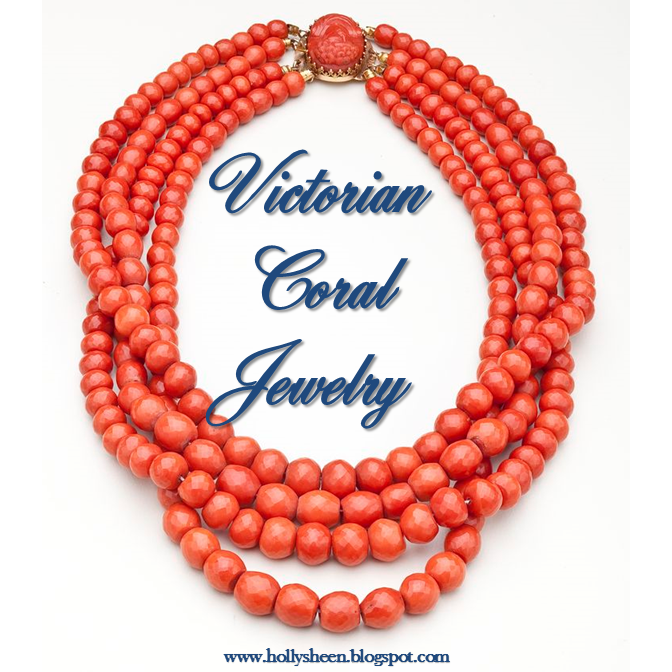
Victorian Coral Jewelry

“Florrie, too, looked very lovely, in her little white dress and coral armlets and necklace, her golden hair curling in little short ringlets all over her head, and her cheeks the color of a May rose.”  Godey’s Lady’s Book, June 1860 [emphasis mine]

The term ‘coral’ describes a vast group of marine invertebrates (animals without backbones). There are at least 100,000 known species throughout the world, and they are found everywhere - from the polar regions to the equatorial regions, and all depths from the intertidal zone to the deepest ocean trenches. Coral also occurs in an amazing array of colors - white, orange, pink, red, tan, gray, lavender and blue, all the way to black.

Coral has been used for jewelry and decorations for centuries by many peoples and has been traded around the world. The Victorians loved coral and an endless variety of beautifully carved jewelry dates from the era.

Because it is fairly soft, coral can easily scratch and scuff. Prolonged lights can cause it to darken and excessive heat can damage the finish. Even sweat from one’s hands can soften coral over time. Therefore, coral jewelry should be carefully taken care of. It is most safely stored in a cloth bag in controlled temperature.

A range of ages wore coral in a variety of ways, as the following quotes and pictures will illustrate:  

Fig. 2.  Zouave jacket of blue armure silk, embroidered.
The shirt, with wide bouffant sleeves, is made of white muslin,
buttoned up in front by a row of coral buttons or studs.
Godey's Lady's Book, July 1861


“Dress for evening, of perfectly plain white grenadine. The under skirt has three flounces of moderate width; the upper one is perfectly plain. There is no pattern, no edge of any description, to the flounces, sleeves, or waist - the richness of the material obviates it - with the exception of a rich satin ribbon, also of plain white, which forms the heading of the berthe, and has a bow on each shoulder and in the centre of the corsage, bracelets and belt-clasp of gold, set with red coral.”   
Godey’s Lady’s Book, July 1860


Le Bon Ton, March 1857

“The headdress consists of a wreath of the foliage of the service tree, intermingled with festoons of coral beads.”  
Godey’s Lady’s Book, September 1860

Portrait of Maria Sawiczewska, Leopold Loeffler, 1861
“The articles in wear for so long a time have been added to this fall - notwithstanding the pressure of the times, and the economical resolves of most families. Among them we note the rich combs of coral, ivory, silver, and gold, intended for evening wear, in full dress.”  
Godey’s Lady’s Book, September 1860

Detail, "Young Roman Girl with Basket of Fruit" (1847)
Johann Endler

“The newest hair nets are made of small shells or coral. They are very pretty and dressy.”
Godey’s Lady’s Book, September 1864

Ferdinand Schauss, Portrait of his wife, 1863
They even had recipes for faux coral as illustrated by this entry from Godey’s.

"ARTIFICIAL CORAL — This may be employed for forming grottos and for similar ornamentation. To two drachms of vermilion add one ounce of resin, and melt them together. Have ready the branches or twigs peeled and dried, and paint them over with this mixture while hot. The twigs being covered, hold them over a gentle fire, turning them round till they are perfectly covered and smooth. White coral may also be made with white lead, and black with lampblack, mixed with resin. When irregular branches are required, the sprays of an old black thorn are best adapted for the purpose; and for regular branches the young shoots of the elm are most suitable. Cinders, stones, or any other materials may be dipped into the mixture, and made to assume the appearance of coral." 
Godey’s Lady’s Book, August 1860

Comtesse Sauvigny, nee Marie Alice Singher by Auguste Pichon 1858
If you love coral as much as I do and need something pretty and Victorian, check out the coral in my shop! Here's a peek at some of my coral jewelry. Thanks for reading!


Victorian Carnelian Jewelry

Blazing fire, autumn color, flashing warmth - all of this is found in the lovely stone known as Carnelian! An interesting semi-precious gem stone we do not usually associate with Victorian jewelry, Carnelian (or Cornelian) is one of the oldest known gemstones and has actually been used decoratively for thousands of years, including the Victorian years.

1st Century B.C.
Found here
ca. 100-300 A.D.
Seen on Pinterest

ca. 1740s Germany
Found on V&A

A form of Chalcedony, Carnelian is transclucent and can range from blood red tones to lighter peachy tones. Other stones are also classified as forms of Chalcedony and a couple can be confused with Carnelian.  The name Sard can be used interchangeably with Carnelian, but it is generally accepted that Chalcedony is designated Carnelian on the redder end of the color spectrum and labeled Sard on the browner end of the spectrum.


Carnelian is as hard as glass. In fact, it is hard enough for engraving and carving. The stone was often used for signet rings because the wax wouldn’t stick to the carnelian. During the Victorian era it was frequently used for watch fobs.

Carnelian Intaglio Watch Fob and Seal

Some jewelry items incorporated Carnelian (or Sard) as an element. Cameos are an example of this. Often the darker colored "background" of a cameo is made from Carnelian. (As an aside, to make things confusing, cameos can be made from Carnelian stone, Sardonyx stone, Carnelian shell, and Sardonyx shell!)

Carnelian Shell Cameo - "Rebekah and the Well"
Seen on Antique Jewelry Mall

Queen Victoria further popularized Carnelian with her love of Scottish jewelry. She had Stuart ancestry and after she purchased Balmoral Castle in Scotland, she enthusiastically embraced all things Scottish. Naturally, fashion followed the Queen! Scottish jewelry often incorporated stones such as Agate, Moss Agate, Carnelian, Bloodstone, Jasper, and Cairngorm. And since the industrial revolution with its more efficient manufacturing techniques was well underway, semi-precious and non-precious jewelry became affordable for the emerging middle class.


You will be right in style accessorizing your 1860s ensemble with Carnelian. In the mid-1860s it seems to most often appear with other stones in jewelry pieces, but now and then it can be seen as a stand-alone element. One of my favorite styles of carnelian is when it is used in drop-style earrings.


I am currently offering Carnelian “drop” earrings in my shop. And if you are interested in purchasing a coordinating pair of Carnelian bead bracelets, let me know and I will custom-make a pair to fit your wrists!

Available in my shop

If you want to have fun looking at more historic Carnelian jewelry, check out my Pinterest board here! Enjoy!

Follow Holly Sheen's board Carnelian Jewelry on Pinterest.