Showing posts with label 1860s. Show all posts

A Bit About Fans

Documentation for the usage of hand fans goes back centuries in time. Used by both men and women, the idea of a fan was an old tradition by the mid-1800s. Fans were a practical accessory as well as a pretty bit of frou frou. Air conditioning was not invented until 1902, so you can understand the need for a fan of some type.

The necessity for fans did not change through the centuries, but the sizes, styles, and materials did change.

Before further elaborating on styles, it will be helpful to note the parts of a fan with this diagram. (Courtesy of the Fan Association of North America (FANA))


In the 1860s there were different styles that were in use:

Folding

As the name implies, made of fabric or paper attached to sticks, this fan neatly folds closed on itself and opens into a semi-circle. During this era, these fans range from 8” to 11”, although 9” to 10.5” are the more commons sizes. The sticks and guards can be made of a variety of materials such as wood, bone, ivory, Mother-of-Pearl, tortoise shell, etc. The Leaf portion can also be made of a variety of materials as noted in the above diagram.

Brise

This fan also folds, but the sticks are of rigid material and are joined in place with a ribbon. The sticks themselves may be decoratively pierced or merely painted. This style varies in size.


Jenny Lind or Palmette

Another folding fan with individual silk leaves or palmettes attached to each stick and sewn together with a thread.

Cockade

A folding fan that opens out into a complete circle. When the fan is opened, the guards come round and are latched together to become the handle.


Fixed 

A non-folding, rigid fan that is fixed on a stick. This type of fan can consist of various shapes, sizes, and materials, and is thought to be the oldest style of fan.


The industrial revolution brought about the concept of mass production and this affected fans as well. In 1859 Alphonse Baude perfected the machine manufacture of fan sticks. This reduced fans from expensive individual art objects to simply mass-produced products. However, this also made fans more affordable to the general public. Still a popular accessory in the 1860s, now nearly every lady could afford a fan of some type.

 At the Theatre, by James Hayllar
 Olga Charlotte Marie Gräfin zu Solms-Tecklenburg, by Eduard Robert Bary

Portrait of a Lady With a Fan, by Franz Xaver Winterhalter
Princess Victoria, by Franz Xaver Winterhalter
Portrait of Mrs Augusta Magniac, by Lord Frederic Leighton

These are some CDVs from my collection showing everyday ladies carrying fans. You can view more of my collection of fan-carrying women on this page on my website.


Gloves in the Mid-1800s

Gloves have been worn for thousands of years. Some gloves were utilitarian, some were symbolic parts of a costume or ceremony, and some were purely a fashion accessory. Since at least the 17th century gloves have been available in three broad categories—leather, fabric, and knitted. Initially gloves were made entirely by hand. In the early 19th century technical innovations began to take place and eventually some mechanization was introduced later in the century.

In the 1860s, gloves are a fashion requirement. Though one can find exceptions in looking at CDVs, generally no lady would be out in public without her gloves. At this point in time gloves are wrist-length and come in a wide variety of materials and colors.

I have compiled a number of excerpts from various sources to give you an overview regarding gloves.

Blue Leather Gloves
Holly Sheen Collection
American Family Encyclopedia of Useful Knowledge or Book of 7223 Receipts and Facts: A Whole Library of Subjects Useful to Every Individual, by T. Webster and Mrs. Parkes (1856)
Gloves are made of various materials; leather, silk, linen thread, cotton thread, cotton cloths, and worsted. The good qualities of gloves are strength, warmth in winter, coolness in summer, elasticity in fitting well, and to be well sewed in the seams. There is a distinction, also, between those which will bear washing and such as will not; likewise in the manner of sewing. 

Of leather gloves there are a great many kinds, according to the quality of the material or the uses for which they are required. Of these the principal are:

Kid gloves, the most beautiful, from their softness, thinness, and elasticity, fitting the hand almost like a second skin. They are white, and dyed of all colours, but white kid is always worn in full dress. Limeric gloves…..Beaver gloves….Woodstock gloves…..Buck-skin….Doe-skin….Tan leather….

Thread gloves are either of linen or cotton thread; but it is the former only that are properly known in the shops by the name of thread gloves….They are a remarkably cool wear in the summer….

Cotton gloves are the cheapest of all and are dyed of various colours….

Jean, sateen, and cambric gloves are cut out of cotton cloth of these names, and sewed together , their use is confined to women.

Silk gloves….The French white are the best; they are also black, and coloured…Gloves are now also made remarkably cheap of spun silk.

Worsted gloves are of many kinds……Worsted gloves, though not so elegant as others, have a great advantage in their real warmth in cold weather.

The above gloves, of silk, cotton, and worsted, and thread, are now generally woven in the loom; knit gloves formerly so common, being seldom to be met with….Elastic wristbands to gloves are a late improvement.


Lavender Leather Gloves
Metropolitan Museum of Art
Gloves, Past and Present, by Willard M. Smith
It was not until the thirteenth century that the ladies of Europe blossomed forth in gloves—not of the mitten variety, but boasting four fingers as well as a thumb. The first to be introduced for the fair sex were made of linen, of simple design, and reached to the elbows to accommodate the short-sleeved gowns of the period. Not before Queen Elizabeth’s time, however, did the elaborately embroider, bejeweled and perfumed glove captivate woman’s fancy and satisfy her feminine dreams of beauty and extravagance.

….The truth of the matter was, French glovemakers early had won the first place in Europe. Struggle as she might, it is exceedingly doubtful whether her rival across the Channel [England] ever could have equaled her prestige. In the seventeenth century, Paris and Genoble enjoyed the monopoly of the glove markets of Europe…During the eighteenth century, however, these cities began to cope with Germany, Italy, Austria, and even Russia, in glove-making.

…About the year 1819, Vallet d’Artois, a French glove manufacturer, invented steel punches in three sizes, each of which would cut, or punch, out of leather two dozen gloves at once. This invention was the first step toward the introduction of modern machinery into the glove industry….

By minutely studying hands in the Hospital of Grenoble, [Xavier] Jouvain discovered and wrote out….thirty-two different sizes of hands. He furthermore recognized five types…this made three-hundred-and-twenty different numbers of gloves…he had discovered the caliber [pattern] in 1834 [and patented it]…

A later contribution to the technique of the glove was the modern style of fastener, introduced about 1855, by M. Raymond of Grenoble….Roux gives credit to Raymond for all the various changes and improvements in glove fasteners which we have today.

At the Opera by William Powell Frith
Gloves, by Valerie Cumming
At the beginning of the seventeenth century it was possible to buy all three types of glove that are available to us today, namely leather, fabric and knitted gloves....

--Regarding leather gloves--
In the eighteenth and nineteenth centuries there were a series of inventions in the textile industry and allied trades which mechanized many processes which had previously depended on the employment of large numbers of handworkers. Many of these advances were resisted, either by workers who were afraid of losing their livelihood, or by the master craftsmen who felt that no machine was capable of rivalling the skills and experience of trained workers……It was left to Xavier Jouvin, a young French medical student who came from Grenoble, the centre of French glovemaking, to develop this idea….he invented a glove pattern or caliber which he patented in 1834….All modern methods of glove sizing and pattern cutting are based on Jouvin’s system.

The other major development which speeded up glove manufacture was the adaptation of the sewing machine to the finicky and specialized stitching of the glove trade.

--Regarding fabric and knitted gloves—
Gloves or mittens of linen, silk or cotton and cut out and sewn in the manner of leather gloves, were not originally considered an adjunct of the glovemaking trade. In the seventeenth and eighteenth centuries they were usually made and supplied by the milliner or dressmaker….The skills required were essentially dressmaking ones, and the gloves or mittens made from fabric were often ordered or purchased because they complemented a particular dress, and because they were cooler and lighter to wear in warm weather or crowded rooms. Their major disadvantage was that they were rarely well fitting, and after one of two wearings they quickly lost their shape and any pretense of fit…..Today fabric gloves are considered a separate category from knitted gloves, but the two areas overlapped considerably during the period 1770-1870.

 
--The etiquette—
The etiquette of glove wearing was an important feature of nineteenth-century life…

The attributes of the perfect lady, the ideal to which many nineteenth-century writers and journalists in women’s magazines directed the aspirations of the susceptible included small hands and small feet. Hands could be made to appear smaller by being mercilessly crammed into tight gloves (it is no accident that glove stretchers appeared at this time to assist the vain purchaser in easing their gloves)...…

Gloves 1860-80 -- Short leather gloves with long lines of pointing on the back of the hand were worn by men and women of all classes in the latter half of the 19th century…..


Glove Making, The Art & The Craft, by Gwen Emlyn-Jones
As a matter of personal ornament, gloves—as distinct from utilitarian gloves—do not seem to have been in general use in Britain until about the thirteenth century, when women began to wear them, usually of linen and reaching the elbow. It was Queen Elizabeth, some three centuries later, who definitely fixed the glove as part of the etiquette and manners of social life.

Perfumed gloves became so universal that they were often given at the universities to college tenants as well as to guests of distinction. They are mentioned by Shakespeare. Winter’s Tale sings of ‘Gloves as sweet as damask rose’, and in Much Ado About Nothing Hero says to Beatrix—‘These gloves the Count sent me, they are an excellent perfume.’ Incidentally, Shakespeare’s father was a glover.


Lady with Gloves
Holly Sheen Collection
Hints on Etiquette (1837)
[To men] Do not insist upon pulling off your glove on a very hot day when you shake hands with a lady. If it be off, why, all very well; but it is better to run the risk of being considered ungallant than to present a clammy ungloved hand.

[Both sexes] Always wear your gloves in church or in a theatre.

[Women] Ladies should never dine with their gloves on – unless their hands are not fit to be seen.


The Behavior Book: A Manual for Ladies (1855)
Above all, do not travel in white kid gloves. Respectable women never do.

It is not admissible to try on kid gloves in a store. After buying a pair, ask for the glove-stretcher, (which they keep in all good shops, for the convenience of the customers,) and then stretch the gloves upon it, unless you have a glove-stretcher at home. This will render them easy to put on when you take them into wear. Glove-stretchers are to be bought at the variety stores; or ought to be. They will save many a new glove from tearing.


The American Family Encyclopedia of Useful Knowledge, or Book of 7223 Receipts and Fact (1859) P. 998

#5907
Kid gloves, the most beautiful, from their softness, thinness, and elasticity, fitting the hand almost like a second skin. They are white, and dyed of all colours, but white kid is always worn in full dress.

#5908
Gloves are made of various materials; leather, silk, linen thread, cotton thread, cotton cloths, and worsted. The good qualities of gloves are strength, warmth in the winter, coolness in summer, elasticity in fitting well, and to be well sewed in the seams. There is a distinction, also, between those which will bear washing and such as will not; likewise in the manner of sewing.

#5909
Machines have been lately invented for sewing leather gloves, by which the process is performed more accurately, and which reduces the price.

#5910
Thread gloves are either of linen or cotton thread; but it is the former only that are properly known in the shops by the name of thread gloves, though it is now a common practice to pass off cotton thread for linen thread. They are a remarkably cool wear in summer, and bear washing perfectlyly; they are sometimes of unbleached yarn.

#5911
Cotton gloves are the cheapest of all, and are dyed of various colours; being warm, they are much in use for common wear.

#5914
Silk gloves; these are of various qualities, determined by their weight and the neatness of the workmanship. The French white are the best; they are also black, and coloured. A figured silk net glove has lately come much into use among ladies; it is extremely elegant, and cool in summer. Gloves are now also made remarkably cheap of spun silk.

#5915
Worsted gloves are of many kinds…..Worsted gloves, though not so elegant as other, have a great advantage in their real warmth in cold weather…….Elastic wristbands to gloves are a late improvement.


Cotton Gloves
Metropolitan Museum of Art
P. 1076

#6476
Wash-leather gloves, as their name implies, may be easily washed with soap and water; when nearly dry, the fingers should be stretched with a piece of wood.

#6477

White and coloured kid gloves are more difficult to clean; but it is said they may be cleaned perfectly by laying them on a clean towel, rubbing them with a piece of flannel dipped in a hot, strong lather of white soap, till the dirt is removed, using as little water as possible. Hang them up at a distance from the fire to dry gradually, and after they are quite dry, pull out the shrivels and stretch them on the hand.

Peterson’s, February 1860
A Paris letter writer states that, as an addition to the ball-room toilet, the distinguished perfumer and glove-maker, Faguer, stitches the white kid gloves with blue, pink, or violet silk, according to the color of the robe with which the gloves are to be worn. The glove, fastened with two buttons on the back of the wrist, is also a novelty.

Peterson’s, April 1860
There is a new caprice in gloves, which has the merit of novelty, if not of beauty—none other than the long Spanish gloves, embroidered in gold or silver, and which will soon, they say, become indispensable additions to a grand toilet.

Peterson’s, September 1860
Kid gloves, or those of Saxon leather embroidered, may now, more easily than ever, be found to match the colors of the dress, for we see them of several new tints, such as gillyflower, deep green, and blue; but very light gloves, as straw or maize, will always be the most stylish, and the only ones that form a suitable complement to an elegant toilet.

Peterson’s, October 1860
The Venetian gloves, which we noticed last winter as a great novelty, are now quite popular. These gloves are embroidered, and bound with a color contrasting with that of the leather, and fasted above the wrist by six small gilt buttons.

Etiquette For All or Rules of Conduct (1861)
Gloves, trifling as they may appear, give the finishing touch to a lady’s dress. They should invariably be worn when out of doors, whether visiting, shopping, at church, concerts, or any place of amusement or public resort. White gloves are worn only in full dress; the colour of the dress should regulate the hues of those worn on other occasions.

English Women’s Clothing in the Nineteenth Century, by C. Willett Cunnington
1861--
Paris kid [gloves], two button….one button…
1862--
Gauntlet gloves for wearing with ‘yachting jackets’


Peterson’s, April 1862
Kid gloves of light color, with one or two buttons, and embroidered in little squares at the back of the hand, are the most distingue.

Peterson’s, February 1864
These now indispensable articles of the toilet were not generally deemed necessary in England until the days of Queen Anne, although their origin is of sufficient antiquity for Xenophon to mention them as a proof of the effeminancy of the Persians. We have Cicero’s authority for saying their use was long customary with the Romans. In the middle ages, gloves were used only by the aristocracy of England, and highly ornament. Even when general in Queen Anne’s time, they were so highly esteemed as to form a customary New Year’s gift.

Peterson’s Magazine, December 1864
Those pleasing hues of yellow, brown, or tan color, are readily imparted to leather gloves, by this simple process; Steep saffron in soft, boiling water for twelve hours; then, having sewed up the tops of the gloves to prevent the dye from staining the insides, wet them over with a sponge dipped into the liquid. The quantity of saffron, as well as of water, depends on how much dye maybe wanted, and their relative proportions on the depth of color required. A common teacup will contain quite sufficient in quantity for a single pair of gloves.

Ecru Leather Gloves
Holly Sheen Collection
Godey’s Lady’s Book, 1860
Where dancing is expected to take place, no one should go without new kid gloves; nothing is so revolting as to see one person in an assembly ungloved, especially where the heat of the room, and the exercise together, are sure to make the hands redder than usual.....

Straw-colored gloves, with two buttons, and worked with lavender color.

Godey’s Lady’s Book, 1861
…The gloves have two buttons at the wrist and scalloped tops.

The Josephine gloves, of a peculiar cut, and the Mathilde glove, bordered at the wrist with a row of dahlia leaves, stamped out, are to be seen on the hands of our belles.

White bonnets are the most becoming to all complexions, but should almost invariably have white strings, to admit of any color dress being worn, as strings of an opposite and not harmonious contrast will spoil the whole appearance of the toilet. The same remark may be applied to the gloves, which should be in strict union with the dress, and if possible, be obtained of the same hue, and where not, steel or stone, or drab-colored or black, for ordinary wear, and lemon-colored for dress.


Godey’s, Lady’s Book, 1862
Gants de Swede, or undressed kid gloves with embroidered backs, are now very fashionable. They are to be had of all colors and styles, and are less expensive than the finished kid gloves.

Godey’s Lady’s Book, 1863
Uniformity of color is one of the principal characteristics of a fashionable toilet at the present day. In Paris, ladies adopt one color for bonnet, mantle, dress, gloves, boots, and parasol. Frequently, also, the petticoat is of the same color.

To Wash White Thread Gloves and Stockings—
These articles are so delicate as to require great care in washing, and they must not on any account be rubbed. Make a lather of white soap and cold water, and put it into a saucepan. Soap the gloves or stockings well, put them in, and set the saucepan over the fire. When they have come to a hard boil, take them off, and when cool enough for your hand, squeeze them in the water. Having prepared a fresh cold lather, boil them again in that. Then take the pan off the fire, and squeeze them well again, after which they can be stretched, dried, and then ironed on the wrong side.


Godey’s Lady’s Book, 1864
We saw at Stewart’s quite a novelty in kid gloves. They were of light colors covered with little waving lines or small stars or pin dots. We mention these merely as a novelty, for they are far from pretty. We particularly admire the buff, stitched with black, and the pure white ones.

Silk gloves have just appeared with Tartan gauntlets, and we suppose will be adopted.


Hillgrove’s Ball Room Guide and Practical Dancer (1863)
The gloves should fit to a nicety.

Gloves should be removed at the supper-table. Servants in waiting are the only persons privileged to wear them.


The Fashionable Dancer’s Casket or the Ball-Room Instructor (1856)
The gloves should fit to a nicety.


Rose O'Neal Greenhow with gloves that "fit to a nicety!"

Victorian Bonnet Veils - Not Just for Mourning

Yes, veils were worn for mourning. However, veils were not just for mourning. Veils were a common, practical fashion accessory in the 1860s and were worn for several reasons.

  • Veils protected the eyes from the sun's glare, just like sunglasses do now.

  • Veils protected the face from flying insects and dust. Remember, buggies, wagons and horse-backing riding didn't provide windshields! 

  • Veils offered a lady privacy. They created a personal space for her, even in a public place.

As you can see from this CDV, veils were worn with both bonnets and hats. These ladies have pulled their veils back so you can see their faces. 


Veils have been worn for centuries so ladies wearing them in the 1860s was not a new idea. Veils were worn by young and old alike. Here is both an older lady and a young lady wearing one.


Regardless of race, income and social position, many ladies wore them. 


They were appropriate for both winter and summer weather. 


Veils generally come in a half-oval shape or some rectangular configuration. They seem to be predominantly black or white, but they can also come in colors such as blue, green, and brown. The following snippets from fictional works of the day will illustrate.

Godey’s Lady's Book, 1861
My Ward
She was muffled up in furs, woolens, shawls till she was nearly as broad as she was long, and wore a heavy brown veil.


Peterson’s Magazine, 1864
Fanny’s Flirtation
As the vehicle drew up, in obedience to my summons, a glance inside discovered two females—one somewhere between sixty and a hundred and fifty, and the other composed principally of green veil drawn well over the face...

Peterson’s Magazine, 1864
The Lost Estate
She stopped and looked after him, thrusting the brown veil aside that covered her face.

Littell’s Living Age, Volume 74, by Eliakim Littell, Robert S. Littell (1862)
Chronicles of Carlingford
He went that way—that way, look!—in a cab, with somebody in a blue veil.


I love this lovely yet practical Victorian accessory! In fact, I offer bonnet veils in my shop. My veils are copied from an original veil in my collection.

Available in my shop

Fichu: A Fun, Frilly Fashion Garment

A Victorian fichu was a gauzy, frilly, large collar or small shawl and was a carry-over fashion garment from the 18th century. Fichus remained popular throughout the 19th century. The word is a French term equivalent to the English ‘neckerchief’ or ‘scarf.’ Deeming it more feminine sounding, the French term ‘fichu’ was eventually adopted in England, America, and elsewhere. 

Nineteenth century fichus became more elegant and changed shape from those of the 18th century. In the Victorian era they were a suitable accessory for day wear as well as evening wear. They varied in shape, style, and fabric, from a small lacey confection to a longer, more dramatic fashion statement.

Following are a few quotes from Godey’s and Peterson’s, leading ladies’ magazines of the day.


Metropolitan Museum of Art

Peterson’s, June 1864
The Eugenie Fichu

This fichu is intended for an evening or a dinner toilet and makes an admirable finish to a dress, besides obviating the necessity of having any further trimming on the bodice. The fichu forms a kind of bodice, open in front, and with two long ends before and behind. It may be made in any bright-colored silk, and is covered with white tulle or net, put plain over the silk, with the exception of the back, which is arranged in five puffings from the waist. The fichus is trimmed round with a narrow black lace, and a wide white lace or blonde, divided by a narrow row of velvet. It is further ornamented with black lace leaves applied on the net or tulle. These leaves can be purchased separately, or they may be cut out from old pieces of black lace, the foundation of which is worn out. The dress has a trimming at the bottom to correspond.


Peterson’s, January 1864


Our fifth engraving is a fichu, trimmed in purple or blue, as the wearer’s taste may dictate.

Peterson’s, February 1864

For dinner or evening dresses, low bodies are very generally worn with a cape or fichu in black and white lace or guipure. For young ladies, silk dresses are often made with a low body, and a small squared shaped cape of the same material to wear over it, the body is then high, and if wished to be worn low, the silk cape is replaced by a tulle fichu, so that the dress is equally appropriate for walking or evening attire.


Barrington House Collection

Godey’s, August 1860

Fichu for summer wear, suited to dinner or evening dress, it is quite as graceful and a newer shape than the favorite Marie Antoinette. The bows may be either of black velvet, or a shade of satin ribbon harmonizing with the dress.

Godey’s, September 1860

Fichu for a low corsage or evening wear. It is of black lace over white; the medallions and ruche being of ribbon. Two rows of good black lace surround it.


Metropolitan Museum of Art

Godey’s, June 1861

The Antionette fichu, with ends crossing either behind or before, is also very much worn with muslin, barege or jaconet dresses. This fichu supplies the place of a high body, and makes, with spencers, a variety in the toilet. It is composed of white muslins, sometimes of either black or white lace.


Seen on Daguerre

Godey’s, August 1862

Besides the white waists, which are worn with low-neck bodies, there are numerous styles of fichus made of muslin, tulle, or lace, and trimmed with ruches, velvets, and bows of ribbon….Many of the fichus cross on the breast, and terminate in long, rounded ends trimmed with velvet, or in pointed ends which fasten underneath the sash or waistband.


My Re-Creations

I own a collection of original, antique fichus. When I decided to offer fichus in my shop, I based my creations on one of the fichus in my collection.

Fichus available in my shop

Croquet Anyone?

Why certainly! I love to play Croquet! So glad you asked!

Croquet was very popular and would have been the “latest and greatest” social outdoor game in the mid-1800s. Why? At the time it was considered the first outdoor game that was approved for men and women to play together. It was not too athletic for ladies and not too effeminate for gentlemen. Peterson’s Magazine (June 1864) extolled, “This capital out-door game for ladies and gentlemen is just now exceedingly popular.”[i] A description of the game and a set of rules followed this declaration. In fact, entire families could play—young and old together.

Not only was Croquet a very social recreation, it was considered very healthful since it was played outside. In the preface to the rulebook, Croquet, by Captain Thomas Mayne Reid, he stated, “Unlike the games already mentioned, it is a sport of the open air, and therefore highly conducive to health; while it has the advantage of most other out-door amusements in affording an easy exercise to the body, without requiring the violent muscular exertion which renders many of these objectionable to persons of delicate frame.”[ii] By the way, this particular rulebook by Captain Reid, copyrighted 1863 and published in Boston and London, is thought to be the earliest American-published rulebook.

John Leech, Punch Magazine
17 August 1861
A nice game for two or more
The exact origins of Croquet are murky. However, descriptions of a similar game actually appear as early as the 1600s, waxing and waning in popularity over the years. Sets of rules were somewhat varied, depending on the era and region, but were not generally codified until the mid-1800s as the game once again emerged into popularity. In the mid-Victorian era Croquet returned to the forefront primarily in England and was then exported to America from there. Initially the game was played mainly by the upper crust of society simply because one had to have a large flat, cleared space for playing. However, it was not long before all societal levels created their own opportunities to play. Eventually the popularity of the game caused it to be the subject of works of art, books, music, and fashion.

Incidentally, a nifty invention was patented that helped ensure the popularity of Croquet when it resurged. This machine was the lawnmower, patented in 1830 by engineer Edwin Beard Budding. How handy not to have to have to use sickles and scythes to tame the lawn!

Creating Our Own Croquet Party
Instead of waiting around for more reenacting events to occur in our region, a few years ago I decided that it was time to invent fun excuses for our local network of reenacting friends to get together more often. We needed an activity that would appeal to men and women, and something that a variety of age groups could play. Hence, our annual Croquet Picnic was born!

Our back yard was sufficient for setting up the playing course, so the venue was taken care of. I had found an 1860s rulebook for Croquet. Next we needed to locate equipment. In reading the rulebook, it gave equipment specifications and it was clear that we needed to find a set or two of mallets that more closely resembled those of the 1860s. The earlier mallets generally have longer handles than most modern sets. I was happy to find some older sets and a decent looking modern set, all of which are wooden with no modern plastic.

We now had a rulebook, a venue, and enough equipment sets to allow plenty of people to play. The next item to make the day complete was to choose appropriate refreshments. None of our network of reenacting friends (which I informally dubbed The Southern Victorian Society) lives in the same town so everyone would be traveling a minimum of about an hour to attend. I finally concluded that having a noon picnic would be the best option since I was hoping the occasion would be a day-long event and I wanted everyone well-fed. And if we were all going to dress 1860s and play this vintage game, it only made sense to have a vintage-style picnic.

Everyone was encouraged to research what foods would be typical Southern fare (since we are all in South Carolina) and to choose appropriate dishes to bring. The idea was enthusiastically embraced and when the day arrived, the picnic tables were laden with delicious foods. Books such as The Carolina Housewife, by Sarah Rutledge; The Robert E. Lee Family Cooking and Housekeeping Book, by Anne Carter Zimmer; and An Antebellum Plantation Household, by Anne Sinkler Whaley LeClercq, were consulted. Our Southern menu included fare such as venison, fried chicken, ham, Hoppin’ John (I even used a heritage Carolina rice for this recipe), pickled okra, skillet cornbread, farm fresh butter, applebutter, seasoned carrots, succotash, pound cake, gingerbread, peach pie, cold cider, iced tea, and more! No one departed hungry!


We set up two long tables for the main meal and another table for desserts. I needed large pieces of fabric to disguise the modern tables and I found several plaid queen-sized sheets that looked good enough until I could find something better. I did find lovely linen napkins, however. We used antique transferware plates, I found goblets that look suitable for the period, and I already had silverware that looked fairly appropriate. We also used antique pitchers for drinks. I encouraged everyone to bring their food in dishes that would complement the 1860s theme as much as possible. Because of our South Carolina weather, we held our picnic in the cooler fall so the table centerpieces were made up of autumn leaves, gourds, pumpkins and the like.

The Croquet Game
Directly after the scrumptious noon meal, those who wanted to play Croquet chose up sides. The game was the afternoon entertainment as the appreciative audience on the sidelines cheered, jeered, and gossiped. My husband, Ray, was the resident technical expert on how to set up the course and how to play the game. He used Beadle’s Dime Handbook of Croquet (reprinted by Sullivan Press) for reference since it was the most easily accessible 1860s handbook at the time. Squabbles over rules were an ongoing issue in the past history of the game, but as nearly as we could tell the disagreements were over minute details and the gist of the game actually did not vary greatly. Therefore, we felt comfortable using the Beadle’s 1866 edition as an accurate representation of the game. Having since found Captain Reid’s rulebook online, we will consult it next time as well.

Succinctly stated, according to Beadle’s, the object of the game is, “…to drive the balls through all the hoops, in the direction indicated by the dotted lines on the diagrams, [The diagram is furnished in the rulebook] and to strike the two posts. The side all of whose members succeed in performing this feat first wins the game.”[iii] This sounds like a friendly, tidy little game until you realize that in order to win, each side may make adversarial moves against their competitors along the way. Several crafty team members on both teams immediately began exploiting any and all opportunities for thwarting the opposition.

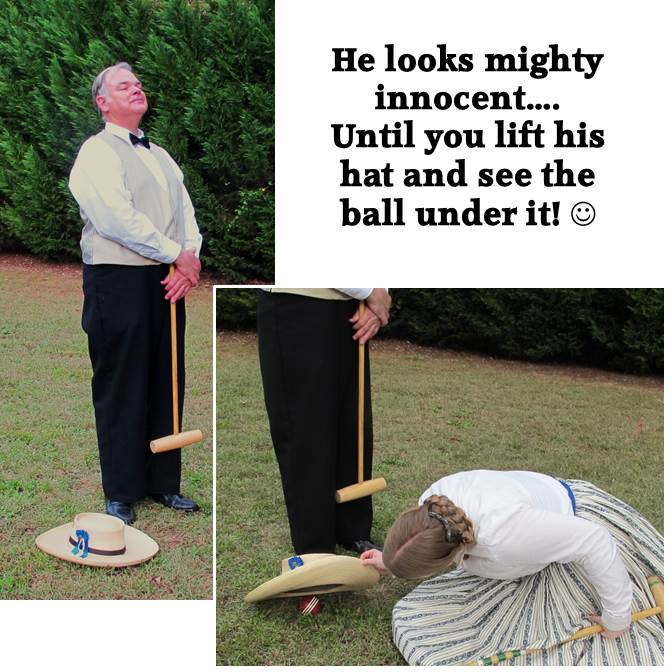
For instance, Beadle’s explains, “If a player hit with his own ball any of the others, he is allowed to place his own against the ball he has struck, and setting his foot upon his own ball, he hits it with the mallet, and the force of the blow drives the opponent’s ball a considerable distance in the direction toward which the mallet is directed.”[iv] Not only that, “…he is at liberty to drive the ball in any direction he pleases.”[v] This is a polite way of saying that your opponents are allowed, and likely, to smack your ball clear out into the bushes if they get the chance! It is then up to you to work your way out of your predicament when your turn comes….or it may even take you several turns to rescue yourself. One must certainly play very strategically and defensively in order to outsmart the opposing team members. Thus, our teams provided much merriment to themselves and the onlookers as each team member struggled to complete the course while performing dastardly tricks on the opposition as often as possible.

You would be mistaken in thinking that when team members complete the course that they are now out of the way and no longer a threat to anyone. Adding to the controlled mayhem, there is yet another complicating factor to be reckoned with. Beadle’s continues, “When a player has passed through all the hoops he becomes what is called in the technical language of croquet a rover, and is privileged to rove about all over the ground, croquing [sic] his friends and foes.”[vi] In other words, the rover could still smack opponents’ balls off course and help his teammates win. As you can see, there can be plenty of challenges for the teams!

The nature of the game also allows ample time for good-natured teasing and light-hearted conversation. In our case, since our group of reenacting friends only see each other now and then, combining this type of social recreation along with the picnic works perfectly for an enjoyable day of visiting. We are all looking forward to our next Southern Victorian Society Croquet Picnic. I highly recommend a croquet party to you and your friends!


Reading List 
Charlton, James, William Thompson, Roger Adler, Katherine Alder, and Andrew Adler. Croquet: Its History, Strategy, Rules and Records. Rev. ed. Lexington, MA: Stephen Greene Press, 1988.

LeClercq, Anne Sinkler Whaley. An Antebellum Plantation Household: Including the South Carolina Low Country Receipts and Remedies of Emily Wharton Sinkler; With Eighty-Two Newly Discovered Receipts. Columbia, SC: University of South Carolina Press, 2006.

Reid, Captain [Thomas] Mayne. Croquet. Boston: James Redpath, 1863.

Routledge, Edmund. Beadle’s Dime Handbook of Croquet. 1866. Reprint, West Chester, PA: Sullivan Press, 1999.

Rutledge, Sarah. The Carolina Housewife. 1847. Reprint, Columbia, SC: University of South Carolina Press, 1979.

Scheuerle, William H. Croquet and Its Influence on Victorian Society: The First Game that Men and Women Could Play Together Socially. Lewiston, NY: Edwin Mellen Press, 2013.

Vernon, H.J. “Croquet and Troco.” Peterson’s Magazine, June 1864.

Zimmer, Anne Carter. The Robert E. Lee Family Cooking and Housekeeping Book. Chapel Hill: University of North Carolina Press, 1997.

Footnotes
[i] H. J. Vernon, “Croquet and Troco,” Peterson’s Magazine, June 1864, 451.
[ii] Captain [Thomas] Mayne Reid, Croquet (Boston: James Redpath, 1863), ii.
[iii] Edmund Routledge, Beadle’s Dime Handbook of Croquet, (1866; repr., West Chester, PA: Sullivan Press, 1999), 12.
[iv] Ibid.
[v] Ibid.
[vi] Ibid., 13.

Ladies’ Aid Societies in the South

April 1862
Sewing societies were organized long ago and every neighborhood has one. Ours meets first at one house and than at another, and all of us sew steadily all day long. Mother cuts many of the garments and Mrs. Manning helps her, that is, when they meet with us. 

July 1862
Three days of each week are devoted to sewing for the soldiers. Often we sew steadily for days at a time, that is when we are getting up a special box to be sent by some soldier, who has been on a visit home and is returning to camp. Cousin Henry Bradford will take the box we are making ready now, he is a Major and certainly looks handsome in his beautiful uniform, just a single star on his collar and chevrons on his sleeves. 

Quoted from my ancestor, Susan Bradford Eppes. 

Southern women rose to the occasion as demanded by the needs of war. They kept the homefront running, but they also provided a great deal of support for the Confederate soldiers. The Confederate government was in its infancy when the war ensued and the Commissary and Quartermaster Departments of the new government were never able to completely catch up to the needs of its soldiers. There was no government legislated “Sanitary” or “Christian Commission” to perform this task. The women of the South saw it as their mission to stand in the gap. Soldier's relief societies and 'Wayside Homes' were organized in communities across the South. Societies met in private homes, churches, schoolhouses, town halls—wherever was convenient.

Thanks to diaries and newspapers of the day recording activities of the ladies, and the fact that some of the societies kept detailed records, we can know with some specificity the sorts of efforts that were made to feed, clothe, and contribute medical supplies for the men. Being in South Carolina, I have chosen to focus primarily on the ladies of this state, though my quoted ancestor above lived in Florida.

Following are some excerpts from the Charleston Mercury and Charleston Courier.

Charleston Mercury, January 3, 1861
The Surgeon-General respectfully and gratefully acknowledges the patriotic response of the ladies to the suggestion to supply bandages. They are rapidly coming in…”

Charleston Mercury, January 5, 1861
The Columbia ladies are receiving contributions for the purpose of aiding in furnishing members of the rifle company with such articles of uniform and equipment as may be necessary, at short notice. Several ladies have agreed to make up the uniforms and are now engaged in the patriotic work. All honor to the ladies of Columbia.”

Charleston Mercury, March 6 and 11, 1861
Surgeon-General Gibbes acknowledges the receipt of $40.00 from a lady of South Carolina, living in New York; $20.00 from a lady in Charleston; and $5.00 from a young lady…and returns thanks for $261.00, given by a lady, for the purchase of surgical instruments.

Charleston Courier, May 8 1861
We learn that the ladies of the little town of Pendleton, hearing that some of the volunteers were in need of uniforms, have offered to make 500 uniforms, in five days, if needed….Besides this, they have raised a subscription for a handsome flag, to be presented to Captain Kilpatrick’s company, now encamped here, and another for a company in Pickens District, under the command of Captain J. L. Shanklin.

Charleston Courier, May 29, 1861
The readiness of the women to help in any way is showed by their offer at this date to make cartridges.

Later we see the relief organizations mentioned. The associations seem to have been very organized and apparently the common practice was to immediately elect or appoint officers.  They also had serious objectives, such as the stated purpose of the Hospital Aid Society of Spartanburg, which read, “to provide garments, hospital stores, and other comforts for our sick and wounded soldiers, and secondly to furnish underclothing, socks, and other articles needed for our soldiers in the field—these objects to be carried out by voluntary contributions of money, material, and labor.”

Similarly, the Greenville Ladies’ Association in Aid of the Volunteers of the Confederate Army stated, “firstly, to relive the sick and wounded among the soldiers, by forwarding to them linen, underclothing, cordials, bed ticks, socks, etc., etc., secondly to make winter clothing for the Volunteers in the Confederate Army.”

The Calhoun Monument Association issued a call for a general meeting. It was recorded in the Mercury as follows:

Charleston Mercury, July 24, 1861
The good work of raising help for our gallant volunteers goes bravely on. Notwithstanding unfavorable weather, a large attendance of ladies took place at the Depository, Chalmers Street, in accordance with previous notice, Dr. Bachman presiding. The meeting was addressed by a number of the clergy of this city.

The objects of the association were stated by the Chair, and contributions invited. One hundred and twenty names were handed in as members, and cash donations of $700, which, with previous donations, make the sum of $1,200… There was also a full attendance at Trinity Church yesterday, all eager to get to work. Contributions filled the doorway. Boxes upon boxes of comforts for the poor sick soldiers have been contributed…..Another meeting will be held today at the Young Men’s Hall, when the ladies who have been cutting out will supply work to those who wish to help….The meeting yesterday was opened with prayer by the Rev. Dr. Girardeau, who requested the ladies to spend the rest of the day collecting sheets, bandages, underclothing and books.

The Soldiers’ Relief Association of Charleston also met that day as noted:
The Depository, in Chalmers Street, Charleston, will be open today, and on every Wednesday, to received contributions from those who desire to aid our sick and wounded soldiers. Old sheets, pillowcases, undergarments, old or new, linen or cotton rags, housekeeping stores, rice, barley, arrowroot, flaxseed, tea, sugar, brandy, wine, especially blackberry, etc., are desired. These will be forwarded to Virginia immediately.

Charleston Mercury, July 25, 1861
A notice of the meeting of the Ladies’ Association in Aid of Volunteer Soldiers, held at the South Carolina Hall. The hall was over-flowing. Nearly $1,000 collected. Officers were elected, but the list was not ready for publication.

Charleston Mercury, July 26, 1861
The Ladies’ Auxiliary Christian Association is now thoroughly prepared to furnish whatever aid may be required by our sick and wounded soldiers.

The committees are organized and working efficiently. Those appointed to cut out and fit work will meet daily at the rooms of the Young Men’s Christian Association in King Street, apposite Beaufain. Several ladies will be in attendance at the same place every day from ten to twelve in the morning, and from six to seven in the afternoon, to receive contributions, distribute work and materials to those wishing to contribute labor, and to receive the garments which have been made.

Charleston not only formed associations, but was so detailed as to designate “ward managers” in the various parts of the area. The managers are listed by name per “ward” and where the particular managers met with their ward volunteers.

According to a Mrs. Brunson of Greenville:
The ladies of our town met at McBee’s Hall, and the basement of the Baptist Church, to sew for soldiers. Country neighbors also formed sewing circles, and some of the old ladies were so expert as to be able to knit as she walked or rode along….I think it was twice a year that a member of the Butler Guards would come with measurements for the men’s clothes, and then the ladies would work hard until these uniforms were finished….The woolen socks were most acceptable to the infantry, as they were soft to their feet while marching….Boxes filled with hams, sausages, dried beef, butter, bread, dried fruit, pickles, etc., were sent on to the soldiers by their families…..Cloth was woven by small hand looms, both cotton and wool. Miss Rydes, a country lady, spun and wove a nice gray woolen cloth and sent it on to General Beauregard as a present.

Ladies of Greenville made nice buckskin gloves, also knit many gloves and scarfs for men of the cavalry and artillery. I could go into the woods now and find the same kinds of leaves with which we colored the wool and cotton. Indigo was planted and used for coloring both wool and cotton….Maidens found, in chests and drawers, a few skeins of scarlet wool, to crochet and knit stripes in scarfs for young friends in artillery service….The flocks of sheep seemed to grow patriotic, giving us fine wool.

Churches in the South had services several times a week, and earnest prayers ascended on high for the safety of our armies, and for consolation to those who had lost their dear ones. Women had been told of their grandmothers’ loyalty and industry during the war with England, and were trying now to show the same love to their defenders.

If one, six, or more men sought shelter and food at private houses while passing through town, they were invited in and entertained….Housekeepers gave away their blankets to any soldiers who needed them….All over the South, ladies met trains, provided with baskets of food and hot, steaming rye coffee for traveling soldiers.

Mrs. Virginia C. Tarrh of Cheraw writes:
Soon after the fall of Sumter, when the best and bravest were making ready to go, the women established a society for making clothes for the soldiers….Every woman learned to knit—even little girls—and I recall one friend, now the wife of a veteran, who learned to spin and weave, and who turned her knowledge to good advantage.
  
Miss S. C. Waring of the Ladies Auxiliary of Black Oak related:
The ladies knit and kept supplied many companies in socks and gloves, caps, shirts, and comforters. For four years we worked unceasingly, and even at evening parties the knitting needle was a regular attendant.

Mrs. W. W. Harlee mentions a fundraiser:
Twice we held entertainments to raise money for the soldiers—one, an exhibition of tableaux, was held in the house at Mars Bluff Depot, and the second was a fair, held in the “Goodwin house,” as it was then called…This fair was quite a success, the articles for sale having been contributed by the ladies of the neighborhood….

Miss Anna Simpson from Pendleton remembered:
Spinning wheels, looms and dye pots were brought into requisition. Wool of home production was speedily converted by loving hands into warm flannels and heavy garments, with sort scarfs and snugly-fitted leggings….Later on, societies were formed to provide supplies for the general demand…Every available fragment of material was converted into some kind of garment.

Miss C. O. Barnewell from Beaufort recalled:
In the summer of 1861, the ladies of this town organized a society for the purpose of working for soldiers. They made coats, pants, caps, comfortables and shirts, which were given to Dunnovant’s regiment, stationed near town.

Mrs. J. P. Adams, a member of the Soldiers’ Relief Association in Columbia, the state capitol, recorded:
Of course, the girls in Columbia, as everywhere else, learned how to knit. Even children could manage suspenders. Some of the girls were expert enough to read aloud while knitting, and in this way the few new books that reached us during the war (Les Miserables and Great Expectations, among others) were often read to an absorbed but industrious group.

The Minutes of the Ladies Relief Association of Fairfield [County] list officers, members, and lists of goods and monies collected. There are the expected items listed such as socks, shirts, drawers, and blankets. But many other interesting items are also specifically mentioned such as the following:
Seventy-two wool comforters
Five pairs gloves
Two quilts
One bushel hominy
One pound black tea
Two bottles honey
One bottle acid drink [citric acid]
Six towels
Ten pounds soap
Four pounds ground coffee
Slippery elm
One bag rice
One bag sugar
Sixteen handkerchiefs
Four tablecloths
One [package] farina
Three bottles lime juice
Six spoons
One jar honey
One-half bushel grits
Nutmegs
Four Hymn Books
Two pounds tapioca
Two spittoons
Two pounds Hyson tea
Pickles
Dried peaches
Six combs and brushes

Similarly, the Greenville Ladies’ Association sent along the basics, but also sent interesting items such as:
12 towels
14 pillowcases
2 curtains
Tracts
2 Bibles
Sage
Sugar
16 tin pans
6 small tin cups
8 large tin cups
1 dressing gown
1 can plums
Cinnamon
Testaments
Hoarhound candy
Sweet potatoes
3 lbs arrowroot
1 ham
60 chickens

The Hospital Aid Association of South Carolina was formed by some of the men of the state in Columbia. A Dr. M LaBorde was president and located in Columbia, and a Reverend Robert W. Barnwell was established up in Charlottesville, VA. Many of the women’s societies sent their supplies to Dr. LaBorde in Columbia who then sent them up to Reverend Barnwell to be distributed as needed.

Lists of articles sent to the hospital in Columbia include many items such as:
Four dressing-gowns
Twelve pairs drawers
Twelve shirts
Twelve pairs socks
One scarf
Twelve comforts
Twelve pillow
Eight pillow-cases
Four bottles brandy
Three of whiskey
Two bottles blackberry vinegar
Two quarts blackberry wine
Five pints blackberry wine
Four dozen candles
Two packages dried fruit
One cake of salve
One small bundle soap
One package herbs
Seven carpet blankets
Four pairs gloves

Many of the associations continued their work until the close of the war. As more and more injured soldiers began to arrive, some of the associations became wayside rests for those going home, and some became hospitals out of necessity. After the war, a number of these organizations became memorial associations.

As noted in the introduction to the published minutes of the Greenville Ladies’ Association in Aid of the Volunteers of the Confederate Army, the records and narratives of the Southern states  ...Apart from their purely local significance, however…serve a broader purpose in chronicling a typical segment of the economic and social life of the Confederacy. The records of the weekly meetings of the society reveal in bold relief the activities which were characteristic not only of this small community, but of the Civil War experiences of women through the South….all disclose in concrete form the patient efforts with which these women exerted themselves to meet the greatest crisis in their history. (1)

1. James Welch Patton, ed., Minutes of the Proceedings of the Greenville Ladies' Aid Association in the Aid of of the Volunteers of the Confederate Arm, 12.