Showing posts with label reenacting. Show all posts

To Match or Not To Match

There is an ongoing discussion among reenactresses as to whether or not ladies of the 1860s matched their accessories to their dresses. On one end of the spectrum we see uninformed ladies buying cloth and making the dress, purse, and shawl out of it - all matching. On the other end we find reenactors cautioning us against being "matchy matchy" in any way. Period. As with all extremes, research shows us that the middle road is usually the most accurate.

In looking at engravings, fashion plates, and paintings of the times, it looks like 1860s ladies both matched and contrasted - just like we do today. While they didn't make their dresses, purses, and shawls out of the same material, they did often coordinate the colors.

Since a picture is worth a thousand words, following is a small sample for illustration.

Notice the lady on the right is wearing a pink dress and matching pink flowers in her hair. However, the lady on the left has chosen to accent her blue gown with white and green - contrasts.
Le Bon Ton, April 1863

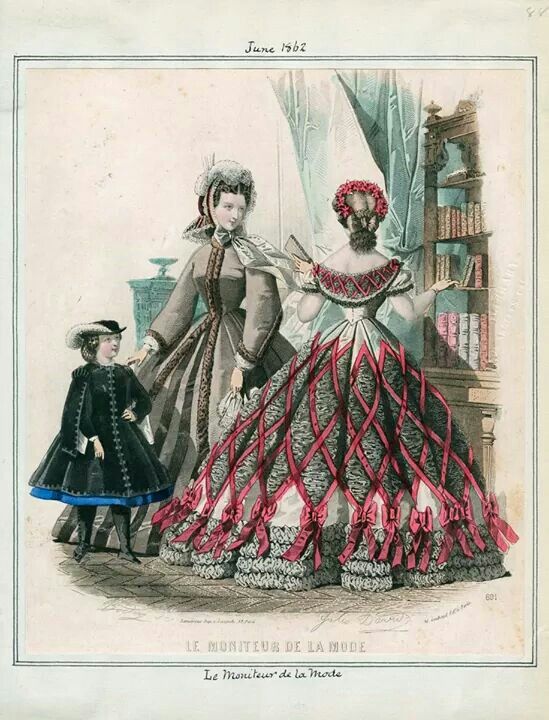
In this fashion plate we see a lady matching her hairpiece to the trim on her dress.
Le Moniteur de la Mode, June 1862

Lest you think that matching is merely a fluke of the person adding color to these fashion plates, here is a formal painting showing some beautiful color matching. Only two shades of blue are used in the ensemble.

Mathilde, by Peirre Franois Eugene Giraud, 1861

Below is a helpful example of both matching and non-matching ensembles. We see the lady in white wearing the same roses on her dress that she has in her hair. On the other hand, we see a lady in purple and yellow wearing red trim! Wow! The lady in the middle front is quite harmonious as she uses pink, white and green florals to compliment her pink dress.

Godey's Lady's Book, January 1862

If you want to see some real "matchy matchiness" going on, take a look at these ladies! Both of them are wearing matching ribbons and flowers on their cap or bonnet. 


Le Monieur de la Mode, 1861

The lady below has matched her cap ribbons to the trim on her morning wrapper. 

Musee des Familles, 1860

Here is another gorgeous example of a complete contrast. This lady has chosen to accent her black dress with striking coral jewelry. 

Portrait of Marii Sawiczewskiej, 1861

This painting  below by John Bagnold Burgess is about as non-matching as you can get - pink dress, black and white hat, gold and white striped shawl and purple parasol!


I'll end with a lovely painting that shows both elements - matching and non-matching - in one lady's outfit. Notice that her neck bow and bonnet ties are apparently created from the same ribbon. However, notice that the bonnet itself is yellow, with a different shade of berries. And her gorgeous shawl has just about every color of the rainbow!

"Look At The Time" by Gustave de Jonghe

It seems pretty clear that Victorians enjoyed both matching and contrasting. The important thing to consider when creating your ensemble is not necessarily whether all of the colors match or not, but whether you are using the right materials for each item. This should rule out the improper "matchy matchy" look of the non-researcher, because we don't typically use the very same materials for every ensemble item - dresses, bonnets, purses, shawls, etc. Once you choose correct materials, enjoying matching or contrasting - it's up to you!

Victorian Agate Jewelry

By the mid-Victorian era, jewelry had become affordable to the ‘mere masses.’ No longer was it the exclusive domain of the upper crust. Consequently, all sorts of experimentation took off in materials to make this middle-class jewelry. The variety is incredible.

Like today, trends often started due to a popular icon’s preferences. One of these jewelry trends was the agate craze because Queen Victoria sentimentally had some agate jewelry made for herself. The popularity of the lowly agate continued for decades.


Agates are definitely correct for your middle-to-upper-class Victorian reenacting impression. Agate jewelry could be found in a variety of price ranges, so many ladies of the 1860s would have been able to afford a piece of agate jewelry. Occasionally I make a pair of agate earrings or bracelets for my shop.

The brooch in the top photo is a good example of banded agates. It shows the "bands" as definite lines throughout.

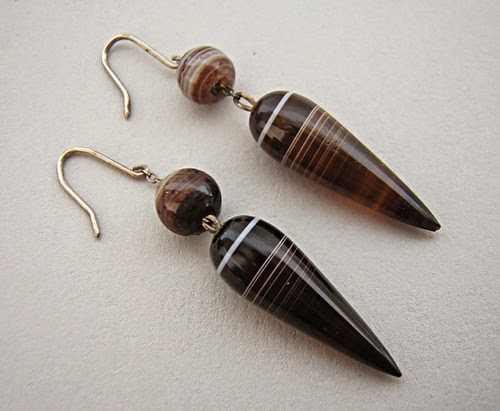
Agate earrings were also very popular. (Notice the plain ‘shepherd’s hook’ earwires.) Almost any shape of bead turned out lovely because of the stripes in the rock.

All sorts of jewelry was made from agates. Notice this lovely cross necklace pendant. The light part of the cross would be translucent when held up to the light. 

Using the natural striations of the agates, different effects could be achieved in multi-stone jewelry. Note how the stripes are combined in the bracelet below.

These are all pictures I've found on jewelry sale sites.

Aren't agates beautiful? This is one of Queen Victoria's styles that I love to wear! 

Breakfast Caps

In the mornings a Victorian lady often wore a "breakfast cap" as she began her day. Breakfast caps were generally fashioned from cambric, fine muslin, or perhaps dotted mull. Ladies' books of the day lobbied for a "simple toilet" for breakfast caps--meaning that trim should only consist of ribbons and narrow lace edging or insertion. For example, Godey's (July 1861) tells us that, "Many ladies prefer muslin and cambric as the material for breakfast caps, and in fact either is more suitable than lace for that purpose, as breakfast is a meal that presupposes negligee [casual attire] and a simple toilet."

However, depending on one's station in life, a "simple toilet" might actually be rather frilly despite the magazine exhortations.

 To the left is a "simple" breakfast cap from Arthur's Lady's Home Magazine in 1863. Lace and ribbons are a common adornment for breakfast caps and this cap features these.

Another breakfast cap is shown in this image below. Most breakfast caps seem to have been made from white fabrics, but do notice that this cap below is constructed of "dotted black lace over white" so there was evidently some variation.


The print below shows quite an elaborate cap that might be a breakfast cap because the lady is shown in her morning wrapper. Notice that this cap has lappets, lace, ribbons, and what appear to be millinery flowers. Not quite a "simple toilet."

Allgemeine Moden-Zeitung, 1862


Another style of breakfast cap.

Would You Wear A Cap?

Reenactresses and docents can also don a breakfast cap with their morning attire. A breakfast cap is a period way of hiding less-than-perfect hair. Upon tidying your hair for the day, you might replace your breakfast cap for a daytime cap that could be more elaborate.

I have also found opportunities to wear my breakfast cap at events with my reenacting girlfriends. And if we are all lodged in the same hotel, we have sometimes made plans to "astonish the natives" by wearing our wrappers and breakfast caps to the hotel's dining room for breakfast!

If you really love Victorian dress, you can wear a breakfast cap any morning! Who wouldn't want to put on one of these darling little creations in the morning? The Victorian ladies might have had the right idea after all!

Looking cute in our wrappers and caps!