Showing posts with label hairpiece. Show all posts

Victorian Bonnet Veils - Not Just for Mourning

Yes, veils were worn for mourning. However, veils were not just for mourning. Veils were a common, practical fashion accessory in the 1860s and were worn for several reasons.

  • Veils protected the eyes from the sun's glare, just like sunglasses do now.

  • Veils protected the face from flying insects and dust. Remember, buggies, wagons and horse-backing riding didn't provide windshields! 

  • Veils offered a lady privacy. They created a personal space for her, even in a public place.

As you can see from this CDV, veils were worn with both bonnets and hats. These ladies have pulled their veils back so you can see their faces. 


Veils have been worn for centuries so ladies wearing them in the 1860s was not a new idea. Veils were worn by young and old alike. Here is both an older lady and a young lady wearing one.


Regardless of race, income and social position, many ladies wore them. 


They were appropriate for both winter and summer weather. 


Veils generally come in a half-oval shape or some rectangular configuration. They seem to be predominantly black or white, but they can also come in colors such as blue, green, and brown. The following snippets from fictional works of the day will illustrate.

Godey’s Lady's Book, 1861
My Ward
She was muffled up in furs, woolens, shawls till she was nearly as broad as she was long, and wore a heavy brown veil.


Peterson’s Magazine, 1864
Fanny’s Flirtation
As the vehicle drew up, in obedience to my summons, a glance inside discovered two females—one somewhere between sixty and a hundred and fifty, and the other composed principally of green veil drawn well over the face...

Peterson’s Magazine, 1864
The Lost Estate
She stopped and looked after him, thrusting the brown veil aside that covered her face.

Littell’s Living Age, Volume 74, by Eliakim Littell, Robert S. Littell (1862)
Chronicles of Carlingford
He went that way—that way, look!—in a cab, with somebody in a blue veil.


I love this lovely yet practical Victorian accessory! In fact, I offer bonnet veils in my shop. My veils are copied from an original veil in my collection.

Available in my shop

To Match or Not To Match

There is an ongoing discussion among reenactresses as to whether or not ladies of the 1860s matched their accessories to their dresses. On one end of the spectrum we see uninformed ladies buying cloth and making the dress, purse, and shawl out of it - all matching. On the other end we find reenactors cautioning us against being "matchy matchy" in any way. Period. As with all extremes, research shows us that the middle road is usually the most accurate.

In looking at engravings, fashion plates, and paintings of the times, it looks like 1860s ladies both matched and contrasted - just like we do today. While they didn't make their dresses, purses, and shawls out of the same material, they did often coordinate the colors.

Since a picture is worth a thousand words, following is a small sample for illustration.

Notice the lady on the right is wearing a pink dress and matching pink flowers in her hair. However, the lady on the left has chosen to accent her blue gown with white and green - contrasts.
Le Bon Ton, April 1863

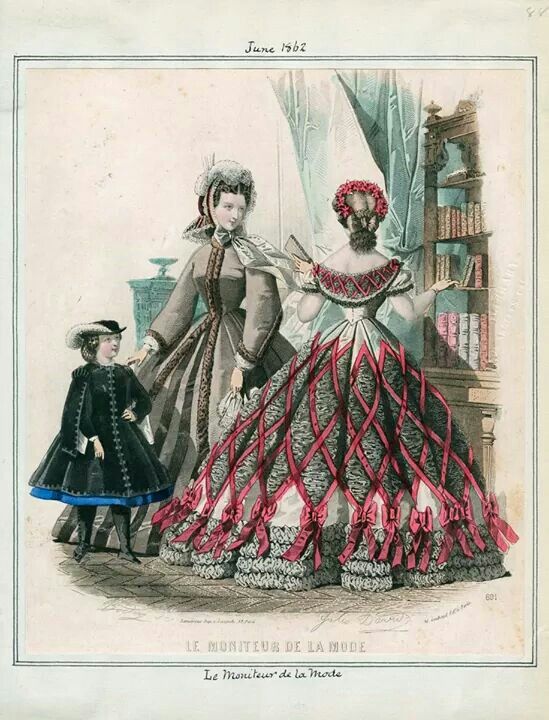
In this fashion plate we see a lady matching her hairpiece to the trim on her dress.
Le Moniteur de la Mode, June 1862

Lest you think that matching is merely a fluke of the person adding color to these fashion plates, here is a formal painting showing some beautiful color matching. Only two shades of blue are used in the ensemble.

Mathilde, by Peirre Franois Eugene Giraud, 1861

Below is a helpful example of both matching and non-matching ensembles. We see the lady in white wearing the same roses on her dress that she has in her hair. On the other hand, we see a lady in purple and yellow wearing red trim! Wow! The lady in the middle front is quite harmonious as she uses pink, white and green florals to compliment her pink dress.

Godey's Lady's Book, January 1862

If you want to see some real "matchy matchiness" going on, take a look at these ladies! Both of them are wearing matching ribbons and flowers on their cap or bonnet. 


Le Monieur de la Mode, 1861

The lady below has matched her cap ribbons to the trim on her morning wrapper. 

Musee des Familles, 1860

Here is another gorgeous example of a complete contrast. This lady has chosen to accent her black dress with striking coral jewelry. 

Portrait of Marii Sawiczewskiej, 1861

This painting  below by John Bagnold Burgess is about as non-matching as you can get - pink dress, black and white hat, gold and white striped shawl and purple parasol!


I'll end with a lovely painting that shows both elements - matching and non-matching - in one lady's outfit. Notice that her neck bow and bonnet ties are apparently created from the same ribbon. However, notice that the bonnet itself is yellow, with a different shade of berries. And her gorgeous shawl has just about every color of the rainbow!

"Look At The Time" by Gustave de Jonghe

It seems pretty clear that Victorians enjoyed both matching and contrasting. The important thing to consider when creating your ensemble is not necessarily whether all of the colors match or not, but whether you are using the right materials for each item. This should rule out the improper "matchy matchy" look of the non-researcher, because we don't typically use the very same materials for every ensemble item - dresses, bonnets, purses, shawls, etc. Once you choose correct materials, enjoying matching or contrasting - it's up to you!

What Style of Cap Was Worn?

An endless variety of ladies' caps were worn in the mid-1860s. Caps had been around for a very long while, so the idea was not new. Only the styling changed to suit the fashions of the day.

As with many items, how elaborate the cap was depended on the formality of the occasion, the type of event, or the lady’s station in life. If you were wealthy, your cap would likely reflect your status. A lady of more moderate means would have a cap of more moderate appearance.

One of my favorite quotes is, "Caps are the most difficult articles to advise on; they almost entirely depend on the taste of the milliner and the fashion of the day." (Godey's, June 1860) Even the trendy Godey’s Lady’s Book could not give any concise or definitive guidelines on what was considered the appropriate look.

I like this cap because it is so straightforward without a lot of fuss and muss. In fact, some of the caps that I create are very similar to this design from Godey’s Lady's Book, July 1860. It is called the "Nell Gwynne" and is simply a "lace piece" gathered at the top with a bow.


Enjoy these carte de vistas from the era that show the variety of caps worn. Some I found online and others are from my collection.

A jaunty lace cap on a young lady


A pretty, and perhaps understated cap


Most definitely showing off her lace lappets!

Certainly this is a grand cap!


Once again, quite the fancy cap!
Note the tones of materials used for the cap—not unusual for this time period 

These ladies are sporting both square and rectangular caps
From "Forgotten Faces and Long Ago Places"

I enjoy making Victorian caps and have many listed in my shop!

My “Headdress” Inspirations

A quick look at fashion plates of the 1860s shows that whenever a formal gown was worn, a lady would nearly always wear some ornament in her hair. There were numerous illustrations of this ornamentation in the ladies magazines of the day, ranging from jewels to laces to flowers and more.

Not only did the ladies love to put all sorts of ornaments in their hair, they would also try to create elaborate hairstyles using all sorts of hairpieces to make their own hair look more impressive. No, all of those amazing hairstyles that you see in the vintage magazines were not solely the lady’s real hair! False hair pieces to enhance one’s appearance were quite acceptable.

However, in considering the modern reenactress and her limitations in hair styling for formal events, I have assumed that most of us don’t have the time or perhaps money to invest in numerous hairpieces to add to our tresses. I have, therefore, chosen several of the simpler illustrations as my inspirations for the ladies of today when creating my headdresses.

At this point, it has seemed most practical - and lovely! - to use the simple crescent and wreath styles to help ladies achieve the 1860s look for their events. Both of these line drawings are from Godey’s Ladies Book, April 1864.

Below are photos of headdresses that I have made for my shop based on the crescent and wreath styles.