Showing posts with label hair. Show all posts

Hairwork – A Jewelry Fad


Throughout time a lock of hair has been an intimate romantic token, a special keepsake, or even commemorative of important events and deeds. The incorporation of human hair in jewelry seems to have begun sometime during the Middle Ages and continued to increase in popularity through the years. Hairwork art and jewelry reached its zenith during the Victorian era, thanks to Queen Victorian favoring the fashion.  

It is known that when her husband, Prince Albert, passed away, the queen wore a heart-shaped locket containing the prince’s hair over her heart. She also wore a bracelet with nine heart-shaped lockets, each of which contained a lock of hair from her children. She also gave a bracelet made of her own hair to Empress Eugenia of France. Hair generally doesn’t decay so these mementos were seen as lasting sentimental tokens. 

An amazing array of jewelry was made from hair - brooches, bracelets, earrings, necklaces, rings, chains, watch fobs, cravat and shawl pins, and so on. Initially this jewelry seems to have been produced primarily by professionals. However, it eventually was viewed as a proper pastime for Victorian ladies and publications such as Godey’s Lady’s Book and Peterson’s Magazine offered “how to” instructions as early as the 1850s.

An Expandable Bracelet


Hairwork bracelets

Two Types of Hairwork

For both types of hair work, the hair would first be cleaned and treated for a few minutes in a solution such as hot water with ‘borax and soda.’ Once soaked, the hair would then be carefully scraped with a knife to make certain to remove any residue.  

Early hairworks were very tiny, intricate designs created on a flat surface of china or glass called a ‘palette,’ thus, often referred to as ‘palette work.’ The design could be anything from a very elaborate miniature scene or a simply a single curl. If creating a scene, small hair clippings were ground with gum Arabic and painted onto ivory, china, or glass. Each design or picture was quite delicate and, therefore, sealed underneath a crystal cover or placed in a special compartment in a piece of jewelry. Some of the favored motifs were landscapes, weeping willows or tombstones (in mourning scenes), Prince of Wales ‘feathers,’ and basketweave patterns for backgrounds to lay hair designs on. 


Hairwork brooches

These brooches contain no hair. Their basketweave backgrounds
are ready for hair to be inserted into the brooch onto the background.

Later on, around the 1830s, another type of hairwork was developed. Referred to as ‘table work’ hair, it actually involved weaving the hair into lace-like, three-dimensional pieces that were quite springy and stretchy. A special table with a hole in the center was used to create this incredibly intricate jewelry.  The hair was specially prepared, strands were counted, and then wound onto bobbins. The hair was then woven into patterns very similar to the method of making bobbin lace. Specialized fittings were added to the finished piece that allowed the hair jewelry to be worn. 

3D hairwork brooches

Hairwork necklace, necklace pendant, and two sets 
of earrings

Antique hairwork jewelry is now very desirable. You can collect old pieces or you can learn to make your own as Victorian ladies did. 

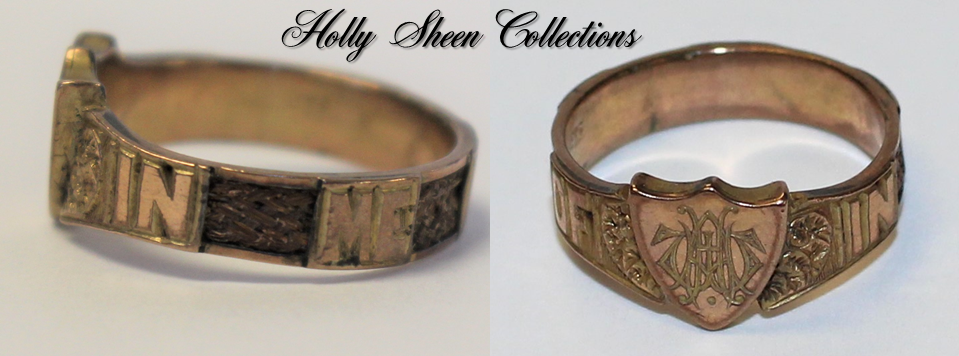
These rings are matching "sister rings." The hair is inserted on the band.
The original owners had their initials engraved on the inside of the band.


Men's watch chains. 


This ring has hair inserted on the band.

Do Only Older Ladies Wear Caps?

We do see many vintage photographs of older ladies wearing caps in the 1860s. Besides being a fashion item, they were also very practical. A cap could hide less-than-perfect hair, particularly for older ladies whose hair might be thinning.

However, caps appealed to a wide range of ages and they came in many styles to accommodate the various age groups’ style preferences. Consider this quote, "Caps are the most difficult articles to advise on; they almost entirely depend on the taste of the milliner and the fashion of the day." Godey's, June 1860. 

While mature ladies most certainly wore caps, younger women also wore them. A few CDVs are presented here to show the cross-section of ages that wore caps, as well as a bit of the variety of styles worn.

A well-dressed older lady with an "statement" cap!

A middle-aged lady with a petite cap 

Obviously an elderly lady
with a fashionable dress and cap

The Viscountess Canning, aged about 42-43, ca. 1860
Met Museum. Accession Number: 2005.100.491.1 (9a)

Here's a sweet image from a Swedish fashion magazine in 1860. Mother has a lovely black chantilly lace cap, and her daughters have a net (left) and a bonnet (right). Quite a tableau!
Nyaste journal for damer 1860. Stiftelsen Nordiska museet.
And finally, here's a lovely young looking woman.


Headpieces on Formal Occasions

Vintage photographs, paintings, and fashion plates from the 1860s illustrate the prevailing trend of ladies wearing some decoration in their hair for formal occasions. A formal event was the perfect excuse to indulge in pretty “bling” for the hair and the ladies' magazines had plenty of advice to offer. Materials used inlcuded everything from flowers, foliage and laces to ribbons, jewels, and feathers... and anything else a lady could think of!

To be correct, a modern lady reenacting a formal 1860s occasion should follow suit. To help those who may not want to make their own, I enjoy making headpieces for ladies. It’s a fun way to vent those creative moments!

Headpieces illustrated in Godey's April 1864 edition

Headpieces illustrated in Godey's August 1864 edition
A Headpiece I designed, inspired by Godey's
Another design of mine


This is a custom piece I made for a friend

Wouldn’t you love to look like Princess Mathilde Bonaparte? 
Her lovely headpiece complements her gown. 

Or maybe you'd like to look like Princess Alice Saxe-Coburg!
Headpieces didn't always match the gown.


Matching the gown or not, nearly all ladies would wear a headpiece with a ball dress.
Le Bon Ton, April 1863


These are headpieces I've been working on for the Olde South Ball Bazaar!

The Olde South Ball is my next formal event and I'll enjoy wearing one of my formal headpieces. Will I see you there? :) (Hint: You can register at this link!)


Pretend you don't see that modern camera I'm holding and instead admire my headpiece! :)

What Style of Cap Was Worn?

An endless variety of ladies' caps were worn in the mid-1860s. Caps had been around for a very long while, so the idea was not new. Only the styling changed to suit the fashions of the day.

As with many items, how elaborate the cap was depended on the formality of the occasion, the type of event, or the lady’s station in life. If you were wealthy, your cap would likely reflect your status. A lady of more moderate means would have a cap of more moderate appearance.

One of my favorite quotes is, "Caps are the most difficult articles to advise on; they almost entirely depend on the taste of the milliner and the fashion of the day." (Godey's, June 1860) Even the trendy Godey’s Lady’s Book could not give any concise or definitive guidelines on what was considered the appropriate look.

I like this cap because it is so straightforward without a lot of fuss and muss. In fact, some of the caps that I create are very similar to this design from Godey’s Lady's Book, July 1860. It is called the "Nell Gwynne" and is simply a "lace piece" gathered at the top with a bow.


Enjoy these carte de vistas from the era that show the variety of caps worn. Some I found online and others are from my collection.

A jaunty lace cap on a young lady


A pretty, and perhaps understated cap


Most definitely showing off her lace lappets!

Certainly this is a grand cap!


Once again, quite the fancy cap!
Note the tones of materials used for the cap—not unusual for this time period 

These ladies are sporting both square and rectangular caps
From "Forgotten Faces and Long Ago Places"

I enjoy making Victorian caps and have many listed in my shop!

My “Headdress” Inspirations

A quick look at fashion plates of the 1860s shows that whenever a formal gown was worn, a lady would nearly always wear some ornament in her hair. There were numerous illustrations of this ornamentation in the ladies magazines of the day, ranging from jewels to laces to flowers and more.

Not only did the ladies love to put all sorts of ornaments in their hair, they would also try to create elaborate hairstyles using all sorts of hairpieces to make their own hair look more impressive. No, all of those amazing hairstyles that you see in the vintage magazines were not solely the lady’s real hair! False hair pieces to enhance one’s appearance were quite acceptable.

However, in considering the modern reenactress and her limitations in hair styling for formal events, I have assumed that most of us don’t have the time or perhaps money to invest in numerous hairpieces to add to our tresses. I have, therefore, chosen several of the simpler illustrations as my inspirations for the ladies of today when creating my headdresses.

At this point, it has seemed most practical - and lovely! - to use the simple crescent and wreath styles to help ladies achieve the 1860s look for their events. Both of these line drawings are from Godey’s Ladies Book, April 1864.

Below are photos of headdresses that I have made for my shop based on the crescent and wreath styles.